A Complete Guide to Apple Computer Data Recovery
In this article
Yes, data can usually be recovered from a Mac, MacBook, or iMac, but the right first move depends on the failure type. Logical problems (deleted files, a failed update, corruption) are highly recoverable if you stop using the machine. Physical failures (clicking, no power, a dead T2/Apple Silicon logic board) need a lab. Never run Disk Utility First Aid on a clicking drive.
- Power it off now: especially if you hear clicking, grinding, or buzzing.
- Don't reinstall macOS or run recovery software on the affected drive: it overwrites your files.
- Identify the failure: silent = logical, noisy/no-boot = physical.
- Get a professional evaluation for irreplaceable data: see MacBook & Mac data recovery.
That moment your Mac fails is one of pure panic. Whether it's the dreaded flashing question mark folder on your iMac or a MacBook Pro that won’t power on, your first instincts can make or break a successful data recovery.
The single most important thing you can do is power it down immediately. This is especially true if you hear any clicking, grinding, or buzzing sounds. Continuing to operate the device can cause irreversible data loss.
Your Mac Is Failing - What to Do First
The first step is to diagnose the type of failure. Broadly, failures are either logical (software-based) or physical (hardware-based). Understanding the difference is critical, as the correct response for one can be catastrophic for the other. The symptoms your Mac is exhibiting are the best clues.
Understanding the Signs of Failure
A physical drive failure often provides audible warnings. If you hear any clicking, grinding, or buzzing from inside your Mac, it is a clear sign of a mechanical issue. These sounds typically indicate that the drive's internal read/write heads are making contact with the platters that store your data, physically destroying it with every rotation.
Expert Tip: Continuing to run a Mac that's making unusual noises is the fastest way to turn a recoverable situation into permanent data loss. Powering it off is not a suggestion; it's the only safe action to preserve your data.
Logical failures, on the other hand, are silent. These are software-based issues and can manifest as:
- Accidentally deleting a folder and emptying the Trash.
- Formatting the wrong drive during a backup.
- File system corruption that prevents macOS from booting.
- A failed macOS update that leaves the system unresponsive.
This troubleshooting flowchart can help you visualize the next steps based on your Mac's behavior.
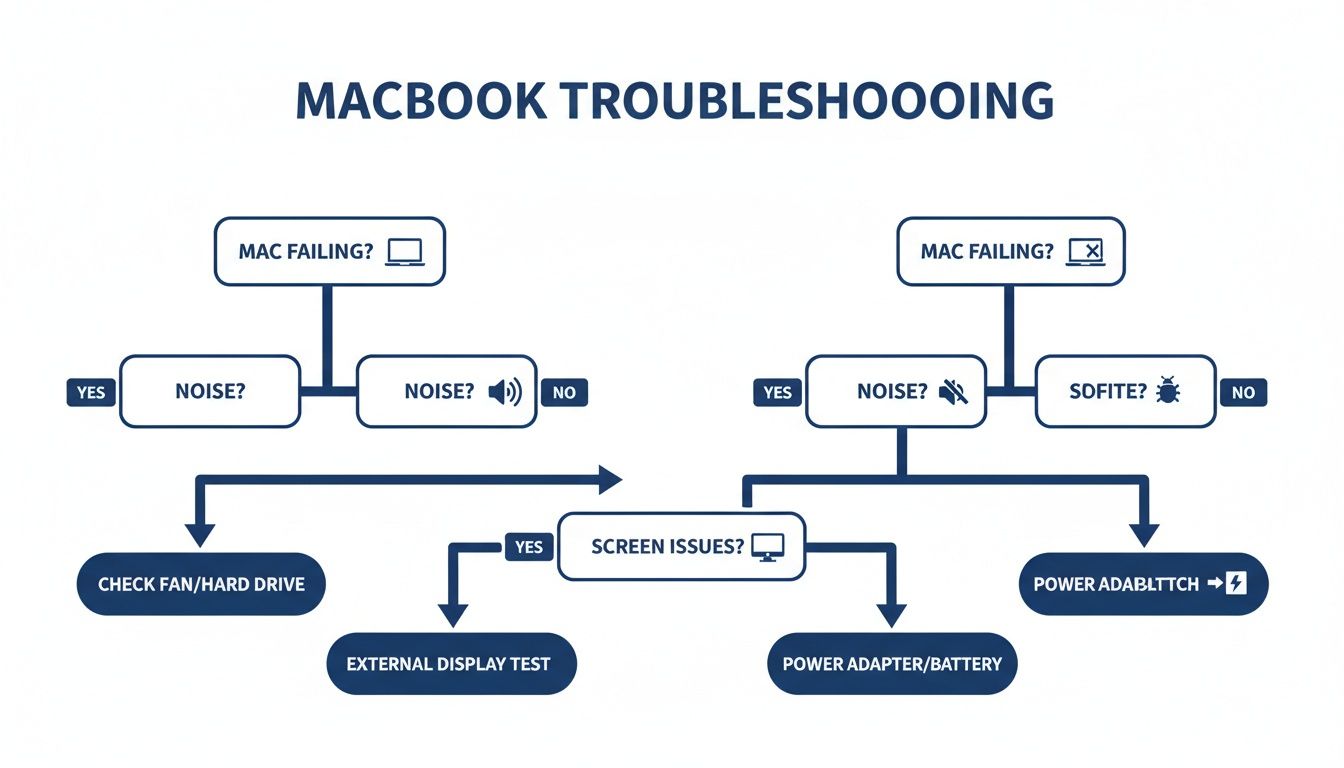
As you can see, any audible noise is an immediate stop sign. Powering down the device is the best way to preserve what's left of your files.
To help you react correctly, here is a quick-reference table based on common failure symptoms.
Immediate Actions for Mac Data Loss Symptoms
This table helps you quickly identify symptoms and take the correct first step to prevent further damage.
| Symptom You're Experiencing | What It Likely Means | Your Immediate Action (Do This Now) |
|---|---|---|
| Clicking, grinding, or buzzing sounds | Physical Failure: The hard drive or SSD is mechanically damaged. | POWER OFF IMMEDIATELY. Do not restart. The drive requires professional lab evaluation. |
| Flashing question mark folder | Logical or Physical: The Mac can't find a bootable OS. The drive may be failing. | POWER OFF. Avoid running software utilities, as this can worsen an underlying physical issue. |
| Kernel panic / constant crashing | Logical or Physical: Can be a symptom of a failing drive, firmware corruption, or a software issue. | POWER OFF. Repeated reboot cycles can accelerate damage to a physically failing drive. |
| Files are missing, but Mac works | Logical Failure: You likely deleted files or have directory corruption. | Stop using the Mac. Continued use can overwrite the sectors containing the "deleted" data. |
Taking the right first step is crucial. An incorrect action can escalate the severity of the data loss.
What Not to Do Under Any Circumstances
In a moment of panic, it is tempting to try any potential solution. However, some common "fixes" are incredibly dangerous for your data.
- Don't Run Disk Utility/First Aid: On a physically failing drive, repair software forces the damaged components to work harder, which can cause further platter damage and make professional recovery impossible.
- Don't Install Recovery Software: Installing any software on the affected drive can permanently overwrite the very files you are trying to recover.
- Don't Keep Rebooting: Each startup attempt places stress on a failing drive, which can compound both physical damage and firmware corruption.
Data loss is a widespread issue. A recent study showed that a staggering 71% of Americans have experienced data loss, with hardware failure being a primary cause. Modern Macs, with their tightly integrated and encrypted hardware, require specialized knowledge and tools to handle data recovery correctly.
The best defense is a robust backup routine. Implementing modern data backup strategies is essential. But if you're reading this, your priority has shifted from prevention to preservation. For irreplaceable data, the safest course of action is to power down the device and seek a professional evaluation. MDRepairs offers nationwide mail-in diagnostics to identify the exact failure without putting your data at further risk.
Diagnosing the Root Cause of Your Mac's Data Loss
To determine a viable recovery path, we must first understand the nature of the failure. Data loss on Apple computers almost always falls into one of four categories: physical, logical, electrical, or firmware failure. Identifying the category is the key to selecting the appropriate recovery methodology.
The symptoms your Mac exhibits provide the best diagnostic clues. For example, a clicking sound from an older iMac with a Fusion Drive is a classic sign of a physical head crash - a catastrophic internal failure. In contrast, a newer MacBook Pro that only shows a flashing folder icon is more likely experiencing logical file system corruption or a solid-state drive (SSD) failure.
Physical vs. Logical Failures
Physical failures mean the storage device itself is mechanically or electronically broken. These are the most urgent cases, requiring an immediate shutdown to prevent further damage.
- Symptoms: Clicking, grinding, or buzzing sounds. The drive may not spin up at all, or the computer may not recognize it.
- Causes: Physical impact from a drop, liquid damage, or component wear on older hard disk drives (HDDs). For SSDs, failures can result from damage to NAND flash chips or the controller.
Logical failures occur when the hardware is functional, but the data has become inaccessible due to software-level problems.
- Symptoms: Accidentally deleted files, an incorrectly formatted drive, a failed macOS update, or frequent system crashes (kernel panics).
- Causes: File system corruption, malware, or user error.
It is impossible to fix a physical problem with software. Running Disk Utility on a clicking hard drive is ineffective and destructive. It forces damaged components to operate, causing platter scoring that can make professional recovery significantly more difficult, if not impossible.
Electrical and Firmware Problems
Sometimes, the failure lies not with the mechanical components or data structure, but with the drive's electronics. An electrical failure occurs when a component on the drive's printed circuit board (PCB) fails, often due to a power surge. This typically renders the drive completely unresponsive.
Firmware is the drive's embedded operating system. When this low-level code becomes corrupted, the drive can behave erratically - it might report its size as 0 MB, become unresponsive, or fail to initialize. These problems are invisible to the user and require specialized lab equipment for diagnosis and repair.
The Modern Mac Complication
Data recovery from modern Macs presents unique challenges. Apple's T2 Security Chip and its M-series successors implement hardware-level encryption that cryptographically links your data to the logic board. If the logic board fails, the SSD cannot simply be moved to another Mac to retrieve the data.
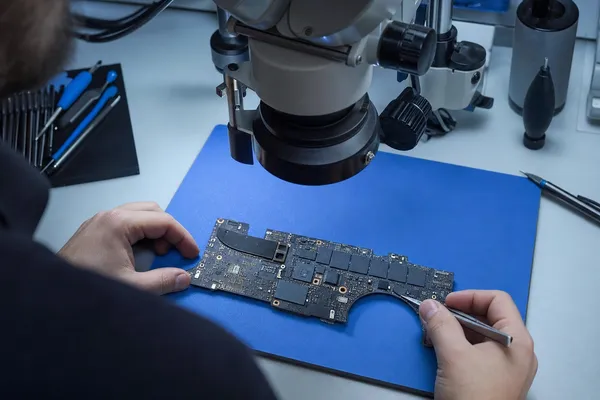
Furthermore, most new MacBooks feature soldered-on SSDs, where the storage chips are physically integrated into the motherboard. If the board or storage fails, recovery becomes a complex micro-soldering operation, far beyond the scope of standard computer repair. This is why we provide guidance on these limitations in our MacBook hard drive replacement article.
This is precisely why professional apple computer data recovery has become a highly specialized field. The MDRepairs lab is equipped to handle these modern complexities, from clean-room procedures on older iMac hard drives to the intricate logic board repairs required for T2-encrypted MacBooks. A professional evaluation is the only way to determine the exact nature of the failure and the potential for a successful recovery.
Safe DIY Checks vs. Dangerous Recovery Attempts
When your Mac fails, the impulse to do something can be overwhelming. However, in data recovery, the line between a safe diagnostic check and a catastrophic mistake is very thin. It is crucial to understand the difference.
Safe actions are non-invasive and do not alter the data on the drive. Think of it as observing a crime scene without touching anything. These checks are designed to gather information without writing new data or placing a physically compromised drive under additional stress.
Safe, Non-Destructive Diagnostics You Can Try
If you suspect a software issue - for instance, your Mac is stuck on the Apple logo but is not making any clicking or grinding noises - a few cautious steps are generally safe. These are purely observational and will not harm a physically sound drive.
- Boot into Recovery Mode: Holding Command+R during startup on an Intel Mac (or holding the power button on an Apple Silicon Mac) will launch macOS Recovery. From here, you can run Disk Utility's First Aid tool. Crucially, only do this if you are certain the drive is physically healthy. If First Aid reports errors it cannot fix, stop immediately.
- Check the Drive on Another Mac: If you have an external drive that has become unreadable, connecting it to another known-good Mac is an effective diagnostic step. Use Disk Utility on the second computer to see if the drive is recognized. This helps determine if the issue is with the drive or your original Mac.
- Use Target Disk Mode: On older Intel-based Macs, Target Disk Mode is a valuable tool. It allows your Mac to function as an external hard drive when connected to another Mac. This can be used to access files, provided there are no signs of physical damage.
The core principle is the same across all Apple devices: first, determine if you are dealing with a logical issue or a hardware failure. This initial diagnosis dictates all subsequent steps, a concept we explore in our guide to professional iPhone data recovery.
Dangerous DIY Attempts That Can Destroy Your Data
Now we must address actions you should never take. These "fixes," often found on forums or in online videos, can turn a recoverable situation into permanent data loss.
The most common mistake is running data recovery software on a physically failing drive. This software is designed for one specific task: recovering deleted files from a 100% healthy drive. When run on a drive with a damaged read/write head, the software forces that component to scrape across the data platters, causing irreversible scoring and destroying your data.
A Professional Lab's Perspective: Imagine a record player with a bent needle. Every rotation carves deeper grooves into the vinyl, ruining the music. Running recovery software on a clicking hard drive is like putting that destructive process on fast-forward.
Here are other common but dangerous attempts:
- Opening the Hard Drive: Hard drives are assembled in certified cleanrooms where the air is filtered to remove microscopic particles. A single speck of dust entering the drive can get trapped between the head and the platter, causing a catastrophic head crash that will instantly destroy your data. Never open a hard drive yourself.
- The "Freezer Trick": This persistent internet myth suggests that freezing a drive will cause metal components to contract, resolving a mechanical issue. In reality, it causes condensation to form directly on the data platters, leading to short circuits and permanent platter damage when the drive is powered on.
- Repeatedly Trying to Boot: Each time you power on a Mac with a failing drive, you subject it to a stressful initialization process. This can worsen physical damage to the platters or compound firmware corruption, making professional recovery more difficult and costly, if not impossible.
When in doubt, the best action is no action. Power down the device and step away. If you hear noises or suspect a physical problem, the next step is a professional evaluation. Our nationwide mail-in diagnostics at MDRepairs can pinpoint the exact failure without risking further data loss.
How Professional Lab Recovery for Apple Devices Works
When a Mac drive arrives at a professional data recovery lab, the process is fundamentally different from software-based attempts. It is a meticulous, hands-on procedure involving specialized tools, controlled environments, and an in-depth understanding of Apple's storage technologies.
The process begins with a thorough diagnostic evaluation in a static-safe environment. We never power on a drive exhibiting signs of physical distress in a standard way. This initial assessment forms the basis of our recovery strategy, allowing us to determine if we are dealing with a physical, logical, electronic, or firmware failure.
Based on this diagnosis, we provide a detailed report on the condition of the drive, a realistic probability of success, and a firm price quote. This is part of our no data, no charge policy - you only pay if we successfully recover the data you need.

Inside the Cleanroom for Physical Failures
If the diagnosis indicates an internal mechanical failure - such as the "click of death" from an older iMac hard drive - the drive must be opened. This can only be performed inside a certified ISO 5 Class 100 cleanroom. This sterile environment is essential, as a single dust particle landing on the drive's platters can cause a catastrophic head crash and permanently destroy data.
Inside the cleanroom, our engineers perform microsurgery on your drive:
- Head Stack Assembly (HSA) Replacement: This procedure involves transplanting the delicate read/write heads from a perfectly matched donor drive to your drive.
- Platter Swaps: In cases of severe motor seizure, we carefully move the data platters into a functional donor chassis.
- Spindle Motor Repair: If the motor that spins the platters is seized, we use specialized techniques to free it without damaging the data surfaces.
These procedures require thousands of hours of training and a vast library of donor drives. They are far beyond the scope of any DIY attempt.
Bypassing Firmware and Electronic Issues
Not all failures are mechanical. Sometimes, a drive's internal firmware becomes corrupted, causing it to report an incorrect size or fail to be recognized by the computer.
In a professional lab, we use specialized hardware tools like the PC-3000 to communicate with the drive in "technological mode." This allows us to bypass the corrupt firmware and directly access the raw data on the NAND flash chips or platters.
This expert-level approach also applies to electronic damage. If a power surge has damaged the drive's circuit board (PCB), a simple swap is not possible. Modern drives store unique adaptation data on the PCB. We must meticulously transfer this critical information from your original board to a healthy donor to regain access to the data.
Tackling Modern Apple-Specific Challenges
The latest MacBooks introduce unique recovery complexities. With SSDs soldered directly to the logic board and encrypted by the T2 chip, the data is both physically and cryptographically tied to the hardware. If the logic board fails, access to the data is lost.
Our lab is equipped for these scenarios. We perform board-level micro-soldering to repair the original logic board just enough to power it on and decrypt the SSD. For SSDs with a failed controller, we may perform a chip-off recovery. This involves de-soldering each NAND memory chip, reading its raw data, and using complex algorithms to reconstruct the file system.
While cloud storage is prevalent, local data loss remains a significant risk, especially as data breaches have tripled in the last decade. When a local Time Machine drive fails, professional apple computer data recovery is often the only solution. As Apple's recent security report indicates, the threats to data are growing, making reliable recovery services more critical than ever.
Regardless of the method, the goal is always to create a perfect, stable, sector-by-sector image of your original drive. From this safe clone, we can then reconstruct the file system and extract your data. For time-sensitive cases, our optional rush service can expedite this entire process.
Preparing Your Apple Device for Shipment to Our Lab
Choosing professional data recovery is the correct decision. Now, let's ensure your device arrives at our lab safely. Proper packing is a critical first step in the recovery process, preventing further damage during transit. A few extra minutes of careful packing can significantly impact the outcome.
Devices that arrive improperly packaged are often in worse condition than when they were shipped. Damage in transit can escalate a standard recovery into a complex, and sometimes impossible, case.

How to Properly Pack Your Device
The objective is simple: the device should not move inside the box. Here’s how to achieve that.
- Use an Anti-Static Bag: Place the drive or computer into an anti-static bag to protect its sensitive electronics from electrostatic discharge (ESD), which can destroy components.
- Wrap Generously in Bubble Wrap: Wrap the device in at least two to three inches of bubble wrap on all sides. Secure it with tape.
- Select a Sturdy Box: Use a new, sturdy cardboard box that provides at least two inches of clearance around the bubble-wrapped device.
- Fill All Voids: Use packing peanuts, foam inserts, or additional bubble wrap to fill all empty space. The device should be suspended and immobilized in the center of the box.
The Shake Test: After sealing the box, give it a gentle shake. If you feel or hear any movement, open the box and add more padding. A securely packed device should be silent.
This preparation is vital. While many assume their backups are sufficient, reality can be different. A surprisingly low 15% of businesses with backups are able to fully restore their data after a loss event. When a backup fails, professional recovery is the only remaining option for complex physical and firmware issues common in apple computer data recovery.
What to Include in the Box
In addition to the device, providing key information helps our engineers work more efficiently.
Please include a note with these details:
- A Description of the Failure: What happened? Did you hear clicking sounds or see an error message? Was the device dropped or exposed to liquid? More detail is always better.
- Device History: Has anyone else attempted to repair the device or recover the data? Knowledge of prior attempts is crucial as it can alter our recovery approach.
- A List of Critical Files: List your most important files or folders. This helps us prioritize the recovery and verify its success. We explain this in more detail in our MacBook data recovery guide.
Once your device is packed, you can start a case on our website. We provide a shipping label and tracking information. Upon arrival, we will perform a complete diagnostic evaluation. Our no data, no charge policy ensures you will not be charged until you approve the firm quote provided after our assessment.
Answering Your Questions About Mac Data Recovery
Losing access to your data is stressful, and it's natural to have questions. Based on our experience with thousands of Apple data recovery cases, here are straightforward answers to the most common inquiries we receive.
Is My Data Truly Gone for Good?
The answer depends entirely on the type of failure and the actions taken after the failure occurred.
For logical issues like accidental deletion or formatting, the chances of a full recovery are high, provided you stopped using the drive immediately. Continued use allows the operating system to overwrite the "empty" space, permanently destroying the original files.
For physical failures, such as a clicking hard drive or a dead SSD, the success rate depends on the extent of the internal damage. Severely scratched platters on an HDD can result in partial, unrecoverable data. On newer Macs with T2 or Apple Silicon chips, the health of the logic board is paramount; if critical components are destroyed, recovery becomes significantly more complex.
A professional diagnostic is the only way to know for sure. We can safely assess the damage and provide a realistic prognosis. Our no data, no charge policy means you only pay for a successful recovery.
Should I Just Try Turning It On Again?
No. This is the single most important rule in data recovery. Powering on a failing device is likely to cause more damage.
- For physical failures: Each spin of a clicking hard drive can cause the read/write heads to score the platters, turning a recoverable situation into permanent data loss. For SSDs, you risk further damage to fragile electronic components.
- For logical failures: Even if your Mac starts, the OS constantly writes log files and temporary data. These background operations can easily overwrite the very files you need to recover.
The safest course of action is to power down the Mac and leave it off.
Can't I Just Use a Data Recovery Program?
Data recovery software has a very specific and limited purpose. It is designed for one scenario only: recovering accidentally deleted files from a 100% healthy, fully functional drive.
It cannot fix physical damage, repair corrupted firmware, or bypass a failed electronic component.
Running software on a physically failing drive is a recipe for disaster. It forces damaged parts to operate under stress, often leading to catastrophic failure. If you hear any unusual noises (clicking, grinding, buzzing) or your Mac does not recognize the drive, software is not the solution. It is a dangerous gamble with irreplaceable data.
What's the Real Cost for Mac Data Recovery?
The price for professional apple computer data recovery depends on the complexity of the recovery process. A simple logical recovery from an accidentally formatted drive is at the lower end of the cost spectrum. A complex case requiring micro-soldering on a MacBook logic board or a cleanroom procedure for a failed hard drive is a much more involved and costly process.
Factors that influence cost include:
- Type of Failure: Logical issues are less complex and less costly than physical or electronic failures.
- Mac Model: Recovering data from a standard external HDD is very different from working on a newer MacBook Pro with an encrypted, soldered-on SSD.
- Need for Donor Parts: Some physical repairs require sourcing a perfectly matched donor drive for parts, which affects the cost.
- Turnaround Time: We offer standard service as well as priority rush services for urgent cases.
We believe in complete transparency. Following our initial diagnostic, we provide a firm, all-inclusive quote. You will know the exact cost before approving any work.
How Long Is This Going to Take?
Like cost, the timeline is specific to each case. A straightforward logical recovery might be completed in a few business days. A physically damaged drive that requires sourcing a rare donor drive for a cleanroom procedure can take longer.
Our standard service is typically completed in 5 to 10 business days after the evaluation is approved. For urgent situations, our priority and emergency rush options can often reduce the turnaround to just 1-2 days. We provide a clear time estimate along with your diagnostic report and quote. With our nationwide mail-in service, you can get a professional assessment from anywhere in the United States.
If your Mac has failed, the next step is a safe, professional evaluation. MDRepairs provides nationwide mail-in diagnostics to pinpoint the cause of failure and give you a clear path forward. Start your case today to get your data on the road to recovery.
Apple Data Recovery When a Mac Will Not Boot
Apple data recovery is different from standard PC recovery because the storage, encryption, and security model vary widely by Mac generation. An older iMac or MacBook may contain a removable SATA hard drive or SSD. A newer MacBook Pro, MacBook Air, Mac mini, iMac, or Mac Studio may use proprietary flash modules or storage that is soldered to the logic board. On T2 and Apple silicon Macs, encryption is tied closely to the hardware, so the recovery path depends on both the condition of the storage and the condition of the board.
If your Mac will not boot, do not erase it, reinstall macOS, or run Disk Utility First Aid repeatedly until you know what failed. First Aid can be useful for minor file system issues, but it is not a data recovery tool. On a failing drive, it can stress weak media. On encrypted APFS volumes, directory damage and snapshot issues need to be handled carefully so the user data volume, keys, and container structure are preserved.
For Intel Macs with removable drives, a lab can often remove the drive, image it, and recover data from the image. For Fusion Drive iMacs, both the SSD and hard drive may be needed because the data can be split between them. For T2 and Apple silicon systems, recovery may require a working logic board path, the user password, and specialized procedures to access the encrypted volume. If the board has liquid damage or power failure, board-level work may be necessary before the data can be decrypted.
The best step is to preserve the Mac in its current state. Keep the password and any FileVault recovery key available. Do not create new accounts, reset the Mac, or accept prompts to initialize disks. MDrepairs handles Apple data recovery for failed MacBooks, iMacs, external Time Machine drives, APFS volumes, and damaged logic boards. For model-specific guidance, see our Mac data recovery service before attempting repairs that could change the storage state.
Frequently Asked Questions
Can Apple recover data from my failed Mac?
Apple may help with backups, iCloud, or hardware service, but many repairs involve replacing or erasing parts rather than recovering data from failed storage. For a Mac with no backup, physical drive failure, APFS corruption, liquid damage, or encryption complications, a data recovery lab is usually the more appropriate path.
Do I need my Mac password for Apple data recovery?
Often, yes. FileVault, T2, and Apple silicon Macs commonly require the user password or recovery key to decrypt the data. A lab may still need to repair hardware or image storage first, but encryption cannot simply be bypassed. Keep passwords and recovery keys available before sending the Mac for recovery.
How MDrepairs can help
Real cases like this come through our New Jersey lab every week. If you are dealing with one now, start here.
- SSD Data Recovery Controller, NAND and firmware recovery for SATA, M.2 and NVMe SSDs. Learn more
- MacBook Repair Logic-board, screen and liquid-damage MacBook repair, NJ. Learn more
- Data Recovery Services Every device and failure type, recovered in our New Jersey lab. Learn more
- Hard Drive Data Recovery Mechanical, firmware and logical HDD recovery on every brand. Learn more