How to Recover a Deleted Folder: A Guide from a Data Recovery Lab
In this article
The sinking feeling when a folder vanishes is a familiar one. What you do in the next few minutes can determine whether this is a simple fix or a permanent loss. The most critical rule is to stop using the drive immediately.
It's a difficult instinct to fight, but continuing to use your computer - even just browsing the web for a solution - is the most damaging action you can take. Your operating system constantly writes temporary files and logs in the background. The "empty" space where your folder's data still resides is the first place it will write new information, effectively overwriting and erasing your files permanently.
What to Do the Moment a Folder Disappears
Panic is a natural reaction, but a calm, methodical approach gives you the best chance of successful recovery. Think of your deleted data as delicate footprints in sand; any new activity will wash them away.
We see this scenario frequently in our lab: a client loses a folder, continues working for another hour, and by the time the drive arrives for diagnostics, background operating system processes have overwritten the critical data structures, making a simple logical recovery impossible.
First Things First: Halt All Activity
Your only priority is to prevent the computer from writing any new data to the storage device.
- If it's your main internal drive (e.g., your C: drive): Do not just close programs or put the computer to sleep. Perform a full shutdown. Power it completely off to stop all background write processes.
- If it's an external drive (HDD, SSD, or USB flash drive): Safely eject it through your operating system, then physically unplug it. Do not plug it back in until you have a clear recovery plan.
A Pro's Perspective: A photographer once lost a wedding shoot folder. He kept his laptop on to research recovery software. During that time, a standard Windows update downloaded and installed itself, overwriting the exact sectors where his photo library was located. This was a completely preventable data loss.
This single step - stopping all use - is the most effective action you can take to preserve your data.
This flowchart outlines the safest path to follow immediately after a folder goes missing.
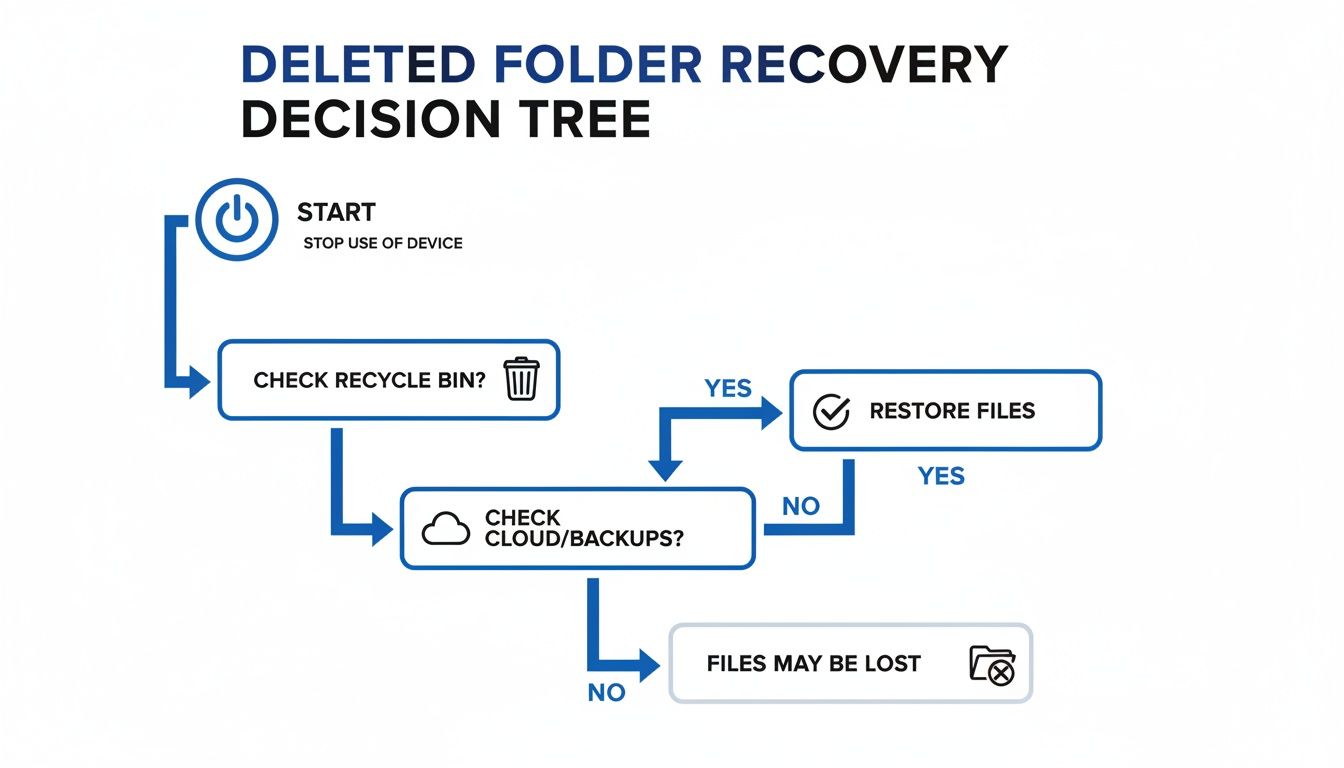
As shown, the process begins with the least invasive checks, preserving the data's integrity before moving to more advanced techniques.
Check the Obvious Places (Safely)
Before considering recovery software, check the system's built-in safety nets. These methods are 100% safe and pose no risk to your data.
- The Recycle Bin (Windows) or Trash (macOS): It may sound basic, but the missing folder is often found here. Open it, and if you see your folder, simply right-click and select "Restore."
- Cloud Service History (Dropbox, Google Drive, OneDrive): If the folder was synced to a cloud service, this can be a lifesaver. Log in to the service's website (not just the local application) and look for a "Trash," "Deleted Files," or "Version History" section. You can often restore the entire folder with a single click.
- Built-in Backups: If you use Time Machine (macOS) or File History (Windows), you may have a recent, safe copy of your folder. These tools exist for this exact purpose.
If one of these simple checks resolves the issue, you're done. If not, it's time to consider the next stage. For those with irreplaceable data, having the device professionally evaluated can save significant time and prevent further data loss.
Why Your Deleted Folder Isn't Immediately Gone
A common misconception is that hitting "delete" instantly erases data. Fortunately, that's not how it works. Modern operating systems are optimized for speed, and permanently erasing data is a slow, resource-intensive process.
Instead, they take a shortcut. Rather than shredding the data, the system simply removes the pointer to it. The actual ones and zeros that constitute your photos, documents, and projects are still on the drive - invisible but intact, at least for a short time.
The File System: A Library's Card Catalog
Imagine your hard drive is a vast library and the file system is its card catalog. When you delete a folder, you aren't burning the books. You are simply discarding the index cards that tell the system where to find them.
The operating system then marks the physical space where those "un-indexed" books reside as "available for use." This is precisely why the single most important action after an accidental deletion is to stop using the drive immediately. Every new file saved, webpage loaded, or even the computer's normal background activity could write a new file on top of your old one, wiping it out permanently.
A Quick Tip from the Lab: From our experience, the highest success rates for logical recovery come from drives that were powered down within minutes of the deletion. The longer a drive remains on, the greater the chance that background OS processes will overwrite the exact sectors required for recovery.
On most Windows computers, the file system is NTFS, and its "card catalog" is the Master File Table (MFT). When a folder is deleted, its entry in the MFT is simply flagged as "free." The information about the folder's name, size, and data location often remains perfectly recoverable for a limited time.
Because the data blocks aren't wiped immediately, the chances of recovering a file or folder are often quite good, provided no new data has been written to the drive. For those interested in the technical details, there's a great breakdown of how NTFS file recovery works on Runtime.org.
Factors Affecting Folder Recovery Success
Not all deletions are equal. The probability of a successful recovery depends on several key technical factors. Understanding these helps set realistic expectations.
Here is what our engineers assess during a professional diagnostic.
| Factor | Impact on Recovery | Explanation |
|---|---|---|
| Drive Usage Post-Deletion | High | Continued use is the leading cause of permanent data loss. Even web browsing creates temporary files that can overwrite the space your folder occupied. |
| Drive Type (HDD vs. SSD) | High | Traditional hard drives (HDDs) retain deleted data until it is overwritten. Most modern solid-state drives (SSDs) use a feature called TRIM, which can permanently erase deleted data almost instantly to maintain performance. |
| File System Fragmentation | Medium | If a folder's files were scattered across the drive (fragmented), reassembling them is more complex than recovering a single, contiguous block of data. |
| File System Health | Medium | Recovering data from a drive with pre-existing logical errors or corruption is significantly more challenging and requires specialized tools. |
Each recovery scenario is unique. A successful outcome depends on a careful analysis of these factors.
At MDRepairs, our nationwide mail-in diagnostics are built on this principle. We begin by creating a perfect, read-only clone of your drive using advanced imaging hardware. This industry-standard practice allows us to work on retrieving your files without ever altering the original media, ensuring we don't cause the very overwriting we aim to prevent. It is the safest and most effective method to maximize the chances of a full recovery.
The Hidden Dangers of DIY Recovery Software
When panic sets in, the first instinct is often to search for "free data recovery tool." This feels proactive, but it is frequently the most destructive step you can take. Installing the first program found can actively destroy the very data you hope to save.
The biggest mistake is installing recovery software onto the same drive as the deleted folder. This action writes new data directly over the "empty" space where your files still linger, effectively making recovery impossible.
The Overwriting Trap
Think of your deleted files as faint footprints in the sand. Installing a new program is like a bulldozer driving over them, causing permanent damage.
Even a small utility can write hundreds of megabytes, enough data to obliterate thousands of documents, dozens of high-resolution photos, or the critical video file you need back.
From the Lab: We've seen it countless times. A client brings in a drive for what should have been a simple, straightforward logical recovery. But first, they tried a free tool they installed on their C: drive to recover files from that same C: drive. This one action turned a 90% recoverable situation into a 0% unrecoverable one.
This is precisely why our primary rule is to stop using the device immediately. Any new activity - including installing software that promises to help - can be the final blow.
Misleading Scans and Incomplete Files
Even if you run the software from a separate, healthy drive, you are not in the clear. Many free or low-cost tools are not sophisticated enough to properly interpret modern file systems.
Here’s what often happens:
- Partial Files: The software finds fragments of your files but cannot reassemble them correctly. You are left with documents that won't open, corrupted photos, and unplayable videos.
- Lost Structure: The tool might recover individual files but dumps them into a single folder with generic names like
file001.docandfile002.jpg. The original folder hierarchy and file names are lost, creating a digital needle-in-a-haystack problem. - Ignoring a Failing Drive: Consumer-grade software assumes the hardware is perfectly healthy. It cannot navigate bad sectors or compensate for firmware issues. Running an aggressive scan on a physically unstable drive can push it over the edge, causing catastrophic platter damage and turning a recoverable case into a far more complex and expensive one.
When Software Can Never Work
It is critical to understand that software is only designed for one specific scenario: logical data loss (like a simple deletion) on a perfectly healthy drive. It is completely ineffective for anything else.
If you are dealing with any of the following, do not attempt to run a recovery program:
- The drive is making clicking, grinding, or buzzing sounds.
- The computer does not recognize the drive or repeatedly asks you to format it.
- The device was dropped, exposed to water, or affected by a power surge.
These are clear symptoms of physical, firmware, or electrical failure. Attempting to run software on a drive with these symptoms will only cause further damage.
In these situations, the only safe course of action is to power down the device and seek a professional diagnosis. MDRepairs offers nationwide mail-in diagnostics to determine the true cause of the failure without further endangering your data.
Recovering Folders from SSDs and Other Modern Devices
When recovering data from modern storage, the old rules no longer apply. The methods that worked for traditional spinning hard drives (HDDs) are ineffective for solid-state drives (SSDs), NVMe drives, smartphones, and most USB flash drives. Understanding the technical differences is key to setting realistic expectations.
Unlike an HDD where deleted files remain until overwritten by new data, modern SSDs use a feature called TRIM. This is a critical maintenance command that keeps the drive performing at top speed. As soon as you delete a folder, the operating system sends a TRIM command to the SSD, indicating that the data is no longer needed. The drive's controller then begins to internally erase those data blocks.
This background cleanup, often called garbage collection, happens constantly. It means your folder is not just marked as deleted - it is being actively scrubbed from existence.
The Extremely Narrow Window of Opportunity with TRIM
This process is what makes SSD folder recovery so difficult. The command is executed incredibly fast.
On most modern SSDs, the TRIM command can wipe deleted data in moments, reducing recovery chances to near zero - often under 10% - just minutes after the deletion. While an old HDD might retain that data for days or weeks, an SSD with TRIM (standard on operating systems since 2009) is actively working against recovery.
The only hope is to act instantly - literally within seconds - before the next TRIM cycle runs. This is why our advice to immediately power down the device is ten times more critical for an SSD. Every second it remains powered on, the drive is one step closer to making the folder's data permanently unrecoverable.
For a deeper technical explanation, CyberCentaurs explains how modern technology handles deleted data in great detail.
Challenges Beyond SSDs
The complexities don't stop with internal drives. Many other common devices have unique failure points that standard software cannot address.
- USB Flash Drives & SD Cards: These devices are prone to controller failure. The controller is the device's "brain," managing data flow between the memory chips and the computer. When it fails, the drive may appear as "unallocated," demand formatting, or report an incorrect size (e.g., 0 MB). This is a hardware problem that no software can fix.
- Smartphones & Tablets (iOS/Android): Modern mobile devices use powerful, file-based encryption by default. Even if the "deleted" data could be accessed, it would be an unreadable, scrambled mess. Recovery requires bypassing the device's core security, a process far beyond the capabilities of any downloadable app.
A Case from Our Lab: A videographer sent us an SD card after accidentally deleting the main folder from a wedding shoot. He had tried three different recovery programs, all of which found nothing. Our diagnostics revealed the problem wasn't the deletion itself but a failing controller chip that was corrupting the file system.
By physically removing the NAND memory chips and rebuilding the card's data structure from the raw dump, we recovered 100% of his video files. This level of recovery is impossible with software alone.
When to Stop and Contact a Professional
If you are trying to recover a deleted folder from an SSD or another modern device, a software-first approach is not only unlikely to succeed - it's risky.
- For SSDs/NVMe: The recovery window is so small that the time it takes to download and run a program is often enough for TRIM to complete its job. The act of trying to save the data can be what destroys it.
- For Flash Media: If the controller has failed, software is useless. The computer cannot communicate with the memory chips.
- For Mobile Devices: Encryption is an insurmountable barrier for consumer software.
In these situations, the only safe and effective option is a professional evaluation. At MDRepairs, our nationwide mail-in service is designed for these complex cases. We utilize specialized firmware tools and direct NAND-access hardware to bypass issues like TRIM, failed controllers, and encryption on devices including HDDs, SSDs, NVMe drives, RAID systems, USB flash drives, SD cards, smartphones, and tablets. Our no data, no charge policy ensures you don't pay unless we recover the specific data you need.
When Professional Data Recovery is Necessary

Sometimes, the smartest move is recognizing when to stop. While a simple, accidental deletion on a healthy drive can often be resolved, pushing forward with DIY methods in the wrong situation can lead to permanent data loss. The line between a successful recovery and a disaster is often drawn the moment you identify signs of a deeper problem.
If your device is exhibiting any signs of physical distress, you must stop everything and unplug it. These are not software glitches; they are hardware emergencies where every second of power-on time could be causing irreversible damage.
Red Flags That Mean "Stop Immediately"
If you observe any of the following symptoms, your next step is not to try another piece of software. It is to power down the device immediately and consult a professional.
- Strange Noises: This is the most critical warning sign. Any clicking, grinding, buzzing, or scraping sounds from a hard drive indicate a severe mechanical failure, likely a head crash where the internal read/write heads are physically gouging the platters that store your data.
- Drive Not Detected: If your hard drive or SSD no longer appears in your computer's BIOS, Disk Management (Windows), or Disk Utility (macOS), you are likely facing a major electrical or firmware failure.
- Serious Error Messages: Pop-ups warning that "The disk needs to be formatted" or that the device is "inaccessible" point to severe file system corruption or a failing controller board.
- Physical Trauma: Any device that has been dropped, exposed to liquid, or affected by a power surge requires professional lab-level evaluation.
A Note from the Lab: Every week, we receive drives where a client heard a faint clicking sound but decided to run "just one more scan." By the time the drive reaches us, the platters are so badly scored that what started as a 95% recoverable case has become completely unrecoverable. That clicking sound is a cry for help - do not ignore it.
These scenarios are far beyond the scope of consumer-grade tools. Attempting to run recovery software on a physically failing drive will only make the damage worse.
What a Professional Lab Does
A professional data recovery laboratory like MDRepairs is equipped with specialized tools and environments that are fundamentally different from a standard repair shop.
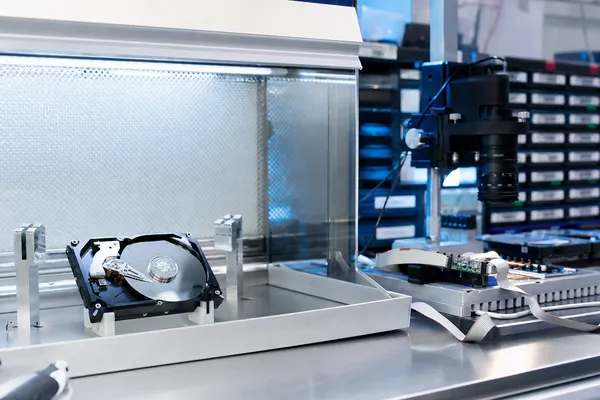
Our engineers work in an ISO-certified clean-room environment to safely open hard drives. This is non-negotiable, as a single dust particle can cause a head crash and destroy the platters. We also use advanced hardware and firmware-level tools to communicate directly with a drive's service area, allowing us to bypass the operating system and access data on devices that a normal computer would see as dead. This is how we address everything from failed HDDs and SSDs to damaged flash drives and smartphones. You can learn more about our specific capabilities and our New York data recovery services.
The Added Complexity of RAID and Servers
For businesses running a RAID system, the stakes are even higher. A deleted folder from a RAID array is not a simple file recovery; it is a complex puzzle involving data striped across multiple physical disks.
While this sounds daunting, RAID levels like 5 or 6 have built-in redundancy. Parity data allows for the reconstruction of information even if one or more drives have failed. When handled correctly by an expert, RAID sets can have very high recovery chances - often up to 95-100% if the file system was not severely damaged. As noted in a guide on the statistical chances of data recovery, the potential for success is high, but only with the right expertise.
If the deleted folder was on a business server, NAS, or other mission-critical system, the safest path forward is a professional evaluation. Our nationwide mail-in diagnostics service offers a free consultation, and our no data, no charge policy ensures you only pay if we successfully recover your data. We also offer an optional rush service for time-sensitive cases.
The Best Recovery Is a Good Backup Strategy
The best recovery plan is never needing one. While we can often achieve successful recoveries, a solid prevention strategy is your best defense against the stress of accidental deletion or a hard drive crash.
A time-tested, industry-standard framework is the 3-2-1 backup rule. It is simple, effective, and protects against almost any data loss scenario.
Adopt the 3-2-1 Backup Rule
This is a proven methodology for data protection. Here’s the breakdown:
- Three Copies of Your Data: Maintain your original files (copy one), plus at least two other backups.
- Two Different Media Types: Store your copies on at least two separate types of storage - for example, your computer's internal drive and an external hard drive. This protects you if one type of media fails.
- One Off-Site Copy: Keep at least one backup copy in a different physical location. An off-site copy protects you from local disasters like fire, theft, or flood.
In practice, this might mean having your files on your laptop, a weekly backup to an external drive, and a continuous backup to a cloud service. It is critical to use robust cloud backup solutions and not just a file-syncing service like Dropbox or OneDrive, which can propagate deletions across all devices.
A Backup You Don't Test Is Just a Hope
Setting up a backup is only step one. A backup you have never tested is not a reliable plan.
Periodically, attempt to restore a few random files or a small folder. This quick check confirms that your backups are running correctly, the media is functional, and the data is not corrupted.
Lab Observation: We frequently encounter cases where a primary drive fails, and the owner discovers their backup job has been silently failing for months. This is a devastating and completely avoidable situation.
By implementing a structured backup strategy and verifying it regularly, you build a safety net you can truly count on. It's the single best thing you can do to avoid the need for data recovery services.
Your Folder Recovery Questions Answered
We receive many questions about recovering deleted folders at our lab. Every situation is unique, and understanding the variables can make a significant difference in a successful outcome. Here are answers to common questions.
Is It Too Late to Recover a Folder I Deleted a Month Ago?
This depends entirely on what has happened on the drive since the deletion.
If the folder was on your main system drive (e.g., C: drive), the chances are low. Your operating system constantly writes temporary files, updates, and logs, which can overwrite the space your old folder occupied, sometimes within hours.
However, if the folder was on an external hard drive or USB drive that has not been used since, there is a much better chance the data is still intact. The only way to know for sure is to have the device professionally evaluated with a non-invasive diagnostic.
Key Takeaway: Stop using the drive immediately. Continued use is the number one enemy of data recovery.
Is It Really Safe to Use Free Data Recovery Software?
If the data is critical or irreplaceable, we strongly advise against using free software. The risks are too high.
- Accidental Overwriting: The most common mistake is installing the recovery tool onto the same drive from which you need to recover files. This action can permanently destroy the data you are trying to save.
- Limited Capabilities: Free tools are basic. They cannot handle complex situations like file system corruption or firmware faults, and they are useless if the drive itself is physically failing.
- Security Risks: Some free programs come bundled with adware, spyware, or other unwanted software.
A professional, read-only diagnostic is the only truly safe first step. It allows an expert to assess the situation without altering any data on your drive, preserving all recovery options.
My External Hard Drive Is Making a Clicking Noise. Is My Data Gone Forever?
Not necessarily, but this is a critical emergency. Unplug the drive immediately.
A clicking sound is a classic sign of severe mechanical failure in a hard drive. It means the internal read/write heads are likely damaged and are striking the magnetic platters where your data is stored. This causes progressive, irreversible physical damage with every click.
Software cannot fix a physical problem. Attempting to run any program will only make the damage worse. This type of recovery requires a clean-room environment, specialized tools, and a technician who can physically repair the drive's internal components before attempting to access the data. We handle cases like this at our Texas data recovery lab, and clients who powered down the drive immediately consistently have the best outcomes.
What Exactly Is Your "No Data, No Charge" Policy?
It is our commitment to providing a completely risk-free service.
After we perform an initial diagnostic, we provide a clear, upfront quote. If you approve the quote, we proceed with the recovery work. If for any reason we cannot recover the specific files you need, you do not pay for the recovery attempt. It's that simple. Our no data, no charge guarantee ensures you only pay for a successful result.
If you are facing a data loss situation, do not guess. A professional evaluation is the safest, most reliable path forward. MDRepairs is a nationwide mail-in data recovery service based in the United States. We offer professional diagnostics to determine exactly what went wrong and how to recover your data. Get started with a free, no-obligation case review.
How MDrepairs can help
Real cases like this come through our New Jersey lab every week. If you are dealing with one now, start here.
- Hard Drive Data Recovery Mechanical, firmware and logical HDD recovery on every brand. Learn more
- SSD Data Recovery Controller, NAND and firmware recovery for SATA, M.2 and NVMe SSDs. Learn more
- Data Recovery Services Every device and failure type, recovered in our New Jersey lab. Learn more
- RAID Data Recovery Array reconstruction for RAID 0/1/5/6/10, NAS and servers. Learn more