External Hard Drive Not Recognized by Computer? A Professional Diagnosis
In this article
When you plug in your external hard drive and your computer doesn't see it, it's an alarming moment. As a professional data recovery lab, we see this symptom daily. Before you panic, it's important to understand that the drive's failure to appear is often a symptom of an underlying issue that can range from simple to severe.
The first critical step is to determine if the problem is a basic connection issue or a sign of internal drive failure. These initial checks are safe, non-invasive, and can quickly help you understand the severity of the situation without risking your data.
First Steps: Safe Initial Diagnostics
When a drive isn't recognized, the goal is to isolate the point of failure. Is it the cable, the USB port, the computer's software, or the drive itself? By methodically checking each component, you can narrow down the possibilities without attempting risky software "fixes" that could make matters worse.
From a data recovery perspective, an unrecognized drive is a symptom. The root cause typically falls into one of four categories of failure. Understanding these helps explain why certain symptoms demand an immediate shutdown while others can be investigated further.
The Four Categories of Drive Failure
When a drive fails to appear, the cause almost always falls into one of these distinct categories:
- Logical Failure: The drive’s hardware is physically sound, but the file system - the "map" to your data - is corrupted or lost. The computer may see the drive in system utilities but might label it as "RAW" or prompt you to format it. (Do not format it.)
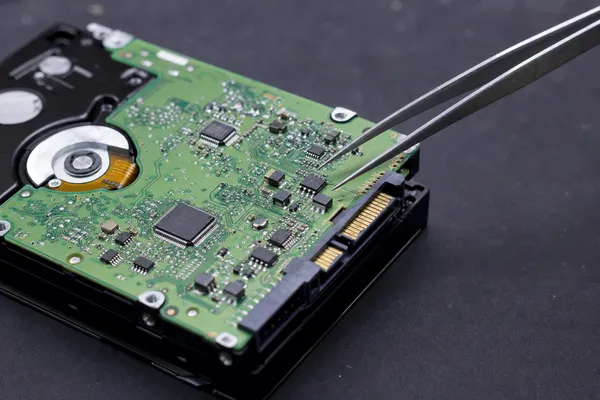
- Electrical Failure: A power surge or faulty component has damaged the Printed Circuit Board (PCB). The drive will be completely lifeless, with no lights, sounds, or spin-up activity.
- Firmware Failure: The drive’s internal operating software has become corrupted. The drive may spin up but fails to properly identify itself to the computer. This is a common and complex failure requiring specialized tools.
- Mechanical Failure: A physical component inside the drive, such as the read/write heads or spindle motor, has failed. This is often accompanied by distinct clicking, grinding, or beeping sounds.
Crucial Safety Warning: If you hear any unusual noises (clicking, grinding, beeping), power down the drive immediately. Continuing to run a mechanically failing drive can cause the read/write heads to scratch the platters, leading to permanent, unrecoverable data loss. This can turn a recoverable case into a hopeless one.
A Safe Troubleshooting Checklist
Before attempting to use any disk utilities or software, perform these simple, non-invasive checks. This checklist helps rule out common external factors.
Initial Diagnostic Checklist: What to Safely Try First
Use this checklist for safe, non-invasive troubleshooting when your external hard drive isn't recognized. It helps rule out common issues before suspecting drive failure.
| Check | Why It Matters | What A 'Pass' Means | What A 'Fail' Suggests |
|---|---|---|---|
| Power Supply | Many 3.5" external drives require a dedicated power adapter. No power means no function. | The drive's indicator light turns on; you can hear or feel it spin up. | The issue is likely the power adapter or the drive's electronics (PCB). |
| USB Cable | Cables are a common point of failure due to wear and tear. | The drive remains unrecognized even with a different, known-good cable. | The original cable was faulty. Problem solved. |
| USB Port | Computer ports can fail, or software drivers can become corrupted. | The drive is not detected in multiple ports, including those directly on the computer's motherboard. | The port or your computer's drivers may be the problem. |
| Another Computer | This is the definitive test to isolate the issue to the drive itself. | The drive is still not detected on a different computer. | The problem is almost certainly with the external drive or its enclosure. |
If you complete this checklist and the drive still fails to appear on multiple computers, the problem is internal to the drive. If the data is important, this is the point to stop all DIY efforts. Further attempts can cause more damage. For a professional evaluation, professional data recovery services in Texas are available, along with nationwide mail-in options.
Diagnosing the Root Cause of an Unrecognized Drive
When an external hard drive is no longer recognized, it is exhibiting a symptom, not the root cause. The specific way the drive is failing provides critical clues. A completely silent drive points to a very different problem than one making a rhythmic clicking noise. Each scenario indicates a different internal failure and requires a unique, specialized recovery strategy.
Attempting to use data recovery software without a proper diagnosis is dangerous. It’s like prescribing medicine without knowing the illness - you can cause significant harm.
Logical Corruption: The Scrambled Map
Logical failure is the most benign scenario. The drive's physical components are healthy, but the file system - the digital table of contents that organizes your files - has become corrupted. Your computer can see the hardware is present, but it cannot interpret the data structure.
Common causes include:
- Improper Ejection: Disconnecting the drive while it is in use can corrupt the file system.
- Sudden Power Loss: An unexpected shutdown can leave the drive in an inconsistent, unreadable state.
- Software Errors or Viruses: Malicious software or application crashes can damage a drive's partition structure.
In this state, the drive often appears in Disk Management (Windows) or Disk Utility (macOS) as "RAW," "Unallocated," or with an incorrect capacity. The operating system will typically prompt you to format the drive.
Stop Right There: Never format the drive when prompted. Formatting erases the existing file system structure, making professional recovery more difficult and potentially less complete.
Electrical Failure: The Silent Drive
An electrical failure typically involves the Printed Circuit Board (PCB) on the bottom of the drive. A power surge, incorrect power adapter, or faulty USB port can damage critical components on this board.
The symptoms are unmistakable:
- The drive is completely unresponsive. No lights, no vibration, no sound.
- In some cases, a faint burnt electronics smell may be present near the connection port.
Fortunately, the data on the platters is usually unharmed. However, modern drives have unique calibration data stored on a ROM chip on the PCB. A simple board swap from an identical drive will not work. A professional must transfer this unique chip from the patient board to a compatible donor board to gain access to the data.
Firmware Corruption: The Identity Crisis
Firmware is the drive's embedded operating system. When it becomes corrupted, the drive can no longer initialize properly or communicate its model, serial number, and capacity to the computer.
The drive might sound healthy - it spins up normally with no unusual noises - but it remains invisible to the operating system. A common example we see at MDRepairs is a firmware bug in certain Seagate models that causes them to get stuck in a "busy" state, effectively locking out all data access.
This type of failure cannot be fixed with software. It requires specialized hardware tools like the PC-3000 to access the drive's service area, diagnose the module corruption, and apply a firmware-level repair. This is a lab-only procedure.
Mechanical Failure: The Physical Breakdown
This is the most critical and time-sensitive type of failure. It signifies that the delicate moving parts inside the drive have physically failed. The most common cause is a head crash, where the read/write heads make contact with the rapidly spinning platters, often due to a drop or impact.
The audible symptoms are a clear warning:
- A rhythmic clicking or ticking noise (the "Click of Death").
- A harsh grinding or scraping sound.
- A series of beeps, which can indicate a seized spindle motor.
If you hear any of these sounds, unplug the drive immediately. Every second it remains powered on, the damaged heads can scrape the magnetic layer off the platters, turning your data into dust. Recovery from mechanical failure requires a certified cleanroom, compatible donor parts, and micro-soldering expertise. This is not a DIY repair scenario.
Recognizing the Signs of Mechanical Hard Drive Failure
When an external hard drive fails to be recognized, a mechanical failure is the most urgent and potentially destructive scenario. This is not a software issue; it is a physical breakdown of the high-precision components inside the drive. Immediate and correct action is required to preserve any chance of data recovery.
Inside a hard disk drive (HDD), your data is stored on magnetic platters spinning at thousands of RPM. A set of read/write heads float on a microscopic cushion of air just nanometers above the platter surfaces. This intricate mechanical design is highly vulnerable to physical shock, making portable drives especially susceptible to failure.
Sounds That Signal a Data Emergency
Your ears are often the best first-line diagnostic tool. Any sound other than a smooth, quiet hum is a sign of internal damage. These noises indicate that components are failing and likely causing progressive damage with every moment the drive is powered on.
Listen for these specific, critical sounds:
- Rhythmic Clicking or Ticking: Known as the "Click of Death," this sound is caused by the read/write heads repeatedly failing to initialize. They sweep across the platters and reset, creating a distinct click each time.
- Grinding or Scraping: This is one of the worst possible sounds. A harsh, metallic grinding indicates that the read/write heads have crashed onto the platter surfaces and are actively scraping away the magnetic layer that holds your data.
- Beeping: Some drives, particularly from Western Digital, use audible beeps to signal a seized spindle motor. The motor is unable to spin the platters, preventing the drive from initializing.
- Complete Silence: While often a symptom of electrical failure, silence can also mean the motor has seized. If the drive receives power but produces no sound or vibration, a motor failure is a strong possibility.
Crucial Action Plan: If you hear any of these noises, the single most important thing you can do is unplug the drive immediately. Do not power it on again. Each attempt scrapes away more of your data, potentially turning a recoverable drive into a total loss.
Debunking Dangerous DIY Myths
In a moment of panic, it is easy to fall for dangerous "quick fixes" found online. These myths are not only ineffective but are almost guaranteed to cause irreversible data loss.
At MDRepairs, we frequently receive drives that have been subjected to failed DIY attempts. The most infamous is the "freezer trick." The theory that freezing a drive can resolve mechanical issues is completely false. It causes condensation to form on the platters, which leads to media corrosion and certain head damage upon power-up.
Another catastrophic mistake is opening the drive's casing outside of a proper cleanroom. Hard drives are assembled in Class 100 cleanroom environments because even a single dust particle is larger than the gap between the heads and platters. Opening a drive in a normal environment causes immediate contamination and ensures platter damage.
Head failures are a significant cause of data loss. Backblaze analysis of thousands of drives found head failures to be one of the top three causes. The good news is that with professional intervention in a certified cleanroom, success rates for these recoveries are very high. This underscores why keeping the drive powered off and sealed is critical. You can discover more hard drive failure statistics to understand the common points of failure.
If your drive is clicking, grinding, or beeping, it requires professional laboratory intervention. Your data is likely still on the platters, but it is inaccessible without a controlled environment and specialized tools. It is time to have the device professionally evaluated via nationwide mail-in diagnostics.
Using System Tools to Diagnose Logical Issues Safely
If your drive powers on and spins quietly without any clicking or grinding, but still doesn't appear in File Explorer, it's possible you are dealing with a logical issue rather than a physical one. This is a critical distinction. Using diagnostic tools on a physically healthy drive is a reasonable next step, but running the same tools on a mechanically failing drive can cause catastrophic data loss.
The goal here is to determine if the operating system can see the drive's hardware, even if it can't read the file system.
What Your Computer Sees
Both Windows and macOS include advanced disk utilities that can often detect hardware that is not visible in the standard file browser.
- For Windows users: Open Disk Management. The fastest way is to right-click the Start button and select it from the menu.
- For macOS users: Open Disk Utility, located in the Applications > Utilities folder.
Once opened, look for a disk that matches the capacity of your external drive. Its presence in this utility is a significant clue.
A drive that appears in Disk Management or Disk Utility but not in your file manager is a classic symptom of a logical failure. This indicates the computer recognizes the physical device but cannot interpret its data structure.
Interpreting the Drive's Status
Within these utilities, the drive will likely display an unusual status. Understanding what these statuses mean is key to determining the next step.
Common statuses for logical failures include:
- RAW: This is Windows' term for a partition with an unrecognized or corrupt file system. The OS sees the partition but cannot identify it as NTFS, exFAT, etc.
- Unallocated: This indicates that the space on the drive is not assigned to any partition. The computer sees the drive as empty, though the data often still exists on the platters.
- No Drive Letter Assigned: In some cases, Windows may simply fail to assign a drive letter. This is the best-case scenario and can sometimes be resolved by right-clicking the partition and manually assigning a letter.
When these logical issues occur, your computer will often suggest a destructive "solution" by prompting you to format the disk.
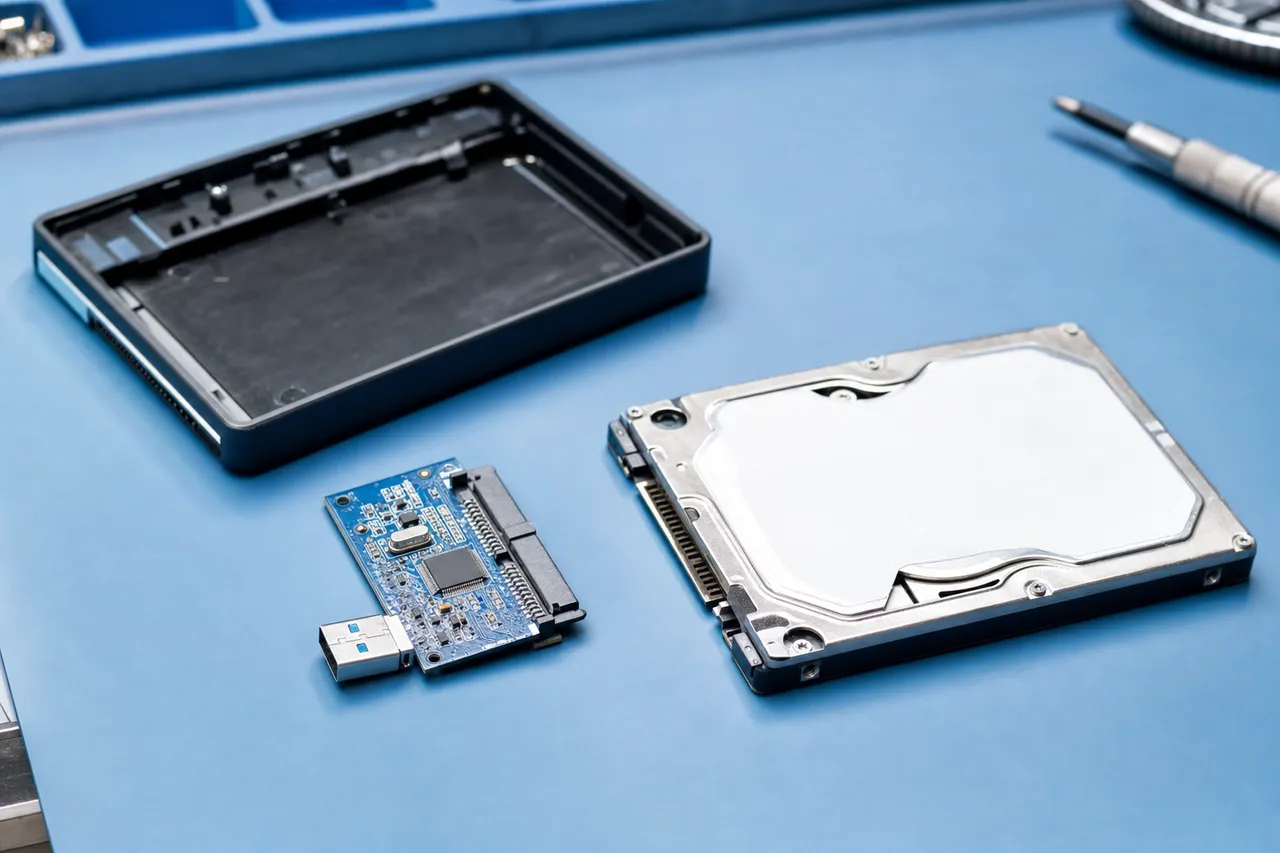
Do not format the drive. This action will erase the file system's "map," making data recovery significantly more complex and often less successful.
This table translates the technical jargon from disk utilities into actionable advice.
Drive Status in System Tools and What It Means
This table helps you interpret what you see in Disk Management (Windows) or Disk Utility (macOS) to understand the state of your external hard drive.
| Status Reported | Potential Problem | Is Recovery Software Safe? | Recommended Next Step |
|---|---|---|---|
| RAW / Unreadable | File system corruption or a damaged partition table. | High Risk. Software scans can stress a physically unstable drive, causing failure. | Create a sector-by-sector clone of the drive before any software attempt. |
| Unallocated Space | The partition has been deleted or lost. | High Risk. Same risks apply; cloning is an essential first step. | Professional evaluation can safely and quickly recover the lost partition structure. |
| Correct but Inaccessible | Permissions issues or minor file system errors. | Moderate Risk. OS repair tools (like CHKDSK) can worsen corruption if run on a failing drive. | Always work on a clone, never the original drive. |
| Not Initialized | The drive's Master Boot Record (MBR) or GUID Partition Table (GPT) is corrupt. | No. This often requires specialized tools to rebuild without data loss. | Stop and have the device professionally evaluated. |
As the table shows, even in purely logical scenarios, using consumer data recovery software carries risk. These programs perform intensive scans that place significant stress on a drive. If there is an underlying physical weakness, a software scan can easily push the drive into complete mechanical failure.
For critical data, the only risk-free path is a professional diagnosis. At MDRepairs, our mail-in diagnostics are designed to identify the exact failure - whether it's logical, firmware, electrical, or mechanical - ensuring the correct recovery strategy is used from the start.
When to Stop and Seek Professional Data Recovery
Knowing when to stop DIY troubleshooting is the single most important decision you can make to ensure the recoverability of your data. It's tempting to continue plugging the drive in, rebooting, or trying different software. However, if the drive is physically failing, each power-on cycle can cause irreversible damage.
This is the moment to shift from being a troubleshooter to a data protector. Certain symptoms are clear indicators of internal mechanical or electronic failure, and proceeding with any further user-level attempts is extremely risky.
The Unmistakable Red Flags
If your external hard drive exhibits any of the following symptoms, the only safe course of action is to power it down immediately and leave it off. These are not software glitches; they are signs of serious physical, electrical, or firmware failure.
- Any Unusual Noises: Clicking, grinding, scraping, or beeping sounds signify an active mechanical failure. The read/write heads are likely making contact with the platters, destroying data with every rotation.
- Drive Fails to Spin Up: A completely silent and vibration-free drive often points to a seized spindle motor or a critical failure on the Printed Circuit Board (PCB).
- Frequent Disconnections: A drive that appears in your system and then quickly disappears is a classic symptom of failing heads, a degraded surface, or deep firmware corruption.
- A "Burnt Electronics" Smell: An acrid smell indicates a short circuit on the PCB. Applying power again risks further electrical damage.
- Visible Physical Damage: Following a drop or liquid spill, you must assume there is internal damage to the fragile components, even if the drive powers on.
This decision tree helps visualize the diagnostic process, highlighting the critical point where a simple issue diverges from a serious hardware failure requiring professional intervention.
As the chart shows, any physical symptom leads directly to one conclusion: power off the device and consult a professional data recovery lab. Continued use is the leading cause of turning a recoverable situation into a permanent data loss.
Why Professional Intervention is Necessary
When a drive displays these red flags, data recovery is no longer a software task. It becomes a hardware-level procedure requiring a specialized laboratory, tools, and expertise. The MDRepairs facility is purpose-built for these scenarios. All internal work on mechanically failed drives is performed inside a Class 100 cleanroom, an environment thousands of times cleaner than a typical room, to prevent microscopic dust from causing further damage.
For complex firmware failures, we use industry-standard tools like the PC-3000 to communicate directly with the drive's service area. This allows our engineers to repair corrupted firmware modules and regain access to the user data area. These capabilities are exclusive to professional labs and are essential for recovering data from modern HDDs, SSDs, and NVMe drives.
Unfortunately, drive failures are not uncommon. A 2023 Backblaze report analyzing over 270,000 drives revealed that the annualized failure rate (AFR) increased to 1.70% from 1.37% in the prior year. Certain models exhibit failure rates exceeding 10%. As the global fleet of hard drives ages, these trends are expected to continue. You can read more about hard drive reliability trends and see the comprehensive data.
Our Professional Commitment: MDRepairs operates on a no data, no charge policy. Following a professional diagnosis, we provide a firm quote. If we cannot recover the specific data you need, you do not pay for the recovery service.
If your data is irreplaceable, do not gamble with it. The moment you suspect a physical failure, stop. Have the device professionally evaluated. Our nationwide mail-in service provides safe, expert diagnostics for clients across the United States.
Your Hard Drive Recovery Questions, Answered
When your external drive fails to appear, it’s natural to fear the worst. The uncertainty is stressful. Here are direct, professional answers to the most common questions we hear from clients in this situation, based on thousands of real-world recovery cases.
Is the Data on My Unrecognized Hard Drive Gone Forever?
In the vast majority of cases, the answer is no. The data is almost always still physically present on the drive's platters, even if your computer can no longer access it.
The critical question is not if the data is gone, but if it is recoverable. Recoverability depends entirely on the type of failure and the actions taken after the failure occurred.
- For logical failures, success rates are extremely high.
- For electrical or firmware failures, specialized lab equipment can often bypass the damaged components to access the data.
- For mechanical failures, a professional lab with a certified cleanroom can often replace the failed internal components and successfully recover the data.
Permanent data loss typically only occurs in cases of severe platter damage, known as rotational scoring. This is why it is absolutely critical to power off a clicking or grinding drive immediately - to prevent this type of irreversible damage.
Why Can't I Just Use a Data Recovery Program to Fix This?
This is a critical distinction. Data recovery software is designed to recover data from functionally healthy hardware. It is effective for scenarios like accidental deletion or formatting a working drive.
However, if a drive is not recognized due to a physical, electrical, or firmware failure, software is at best useless and at worst destructive.
Running an intensive software scan on a drive with failing read/write heads forces those damaged components to work harder, accelerating their degradation and increasing the risk of a catastrophic head crash. This is attempting to solve a hardware problem with a software tool - an approach that often leads to permanent data loss. At MDRepairs, our process always begins with a physical diagnosis to ensure we use the correct, safe method for the specific failure type.
What Does a Professional Data Recovery Process Involve?
Our process is systematic, transparent, and focused on data integrity. It begins with a professional, no-obligation diagnosis to identify the precise point of failure.
- Mechanical Failure: If internal components have failed, the drive is taken into our certified Class 100 cleanroom. There, our engineers can safely open the drive and replace parts like the head stack assembly using components from a matching donor drive.
- Firmware Failure: For corrupted firmware, we use specialized tools like the PC-3000 to directly access and repair the damaged code in the drive's service area, restoring its functionality.
- Cloning: Once the drive is temporarily stabilized, our first step is to create a sector-by-sector clone on a healthy lab drive. All subsequent recovery work is performed on this clone, preserving the original drive in its initial condition.
- Extraction: Finally, we work from the clone to reconstruct the file system, extract your files, and copy them onto a new, healthy external drive for return. We provide this service to clients across the United States through our nationwide mail-in service.
How Much Does Professional Data Recovery Cost?
The cost of data recovery is directly related to the complexity of the failure. It is determined by the engineering time, specialized tools, cleanroom work, and donor parts required to resolve the issue.
A straightforward logical recovery represents the lowest price tier. More complex firmware or electronic repairs are in the mid-range. The most intensive and costly recoveries are mechanical failures that require cleanroom intervention and sourcing compatible donor drives.
At MDRepairs, we provide a firm, transparent quote after our diagnostic evaluation is complete. We also adhere to a strict 'no data, no charge' policy. If we are unable to recover the specific data you require, you owe nothing for the recovery service attempt. This ensures you know the exact cost and potential for success before making any commitment.
If your critical files are inaccessible on an external hard drive that your computer no longer recognizes, stop. Do not risk making the problem worse with further DIY attempts. Have the device professionally evaluated by a dedicated data recovery laboratory. MDRepairs offers professional diagnostics for all storage devices, including HDDs, SSDs, and RAIDs, via our nationwide mail-in service. Learn more at https://mdrepairs.com.
How MDrepairs can help
Real cases like this come through our New Jersey lab every week. If you are dealing with one now, start here.
- Undetected Hard Drive Recovery Recovery when a drive is not detected or shows no capacity. Learn more
- Hard Drive Data Recovery Mechanical, firmware and logical HDD recovery on every brand. Learn more
- Data Recovery Services Every device and failure type, recovered in our New Jersey lab. Learn more
- Mail-In Data Recovery Free insured shipping both ways, anywhere in the US. Learn more