How to Recover Deleted Data From an SD Card: A Lab Perspective
In this article
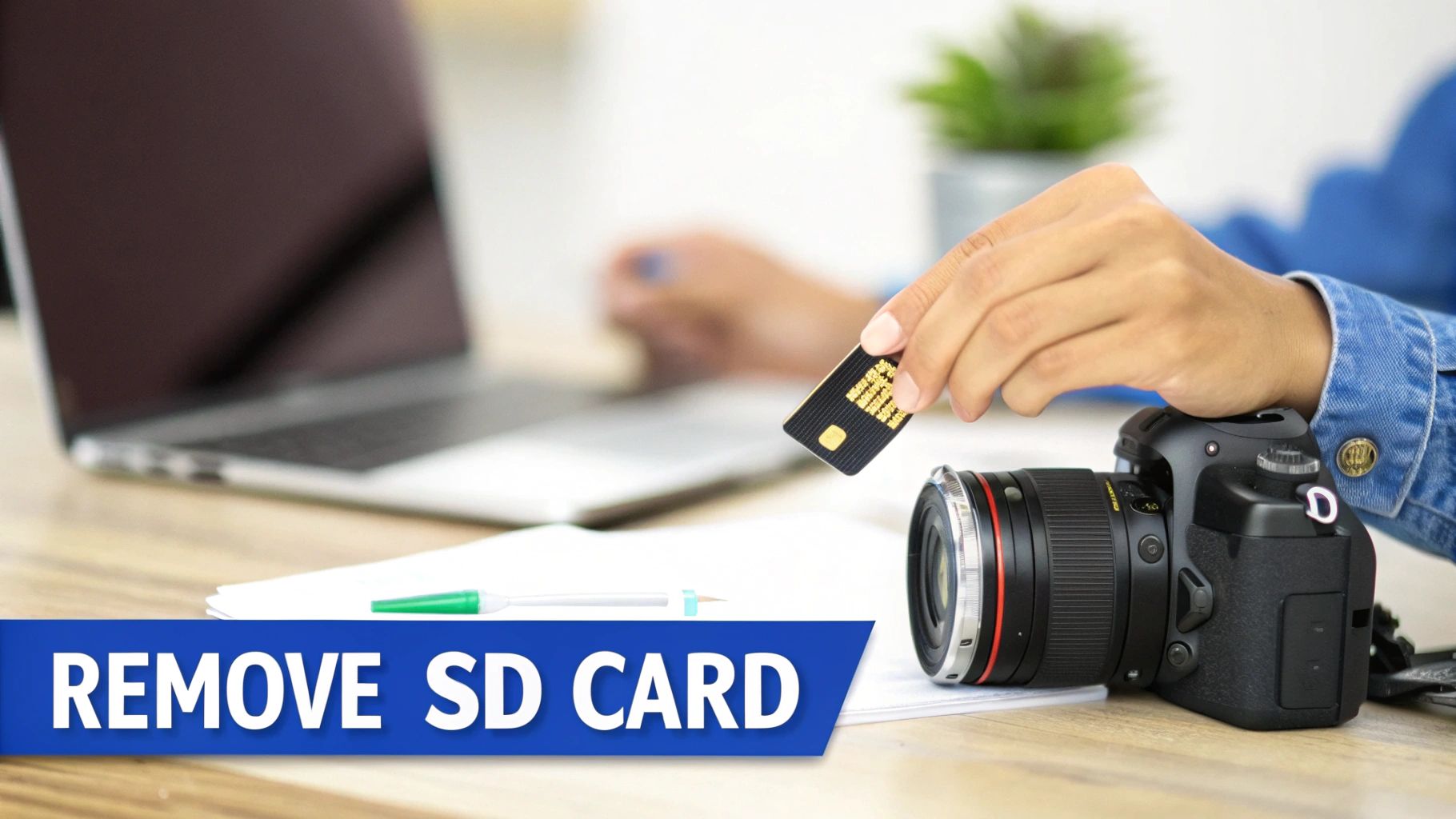
The sinking feeling of realizing you’ve accidentally deleted files from an SD card is a common experience. What you do in the moments that follow is critical to a successful recovery. The single most important rule is to immediately stop using the card. Power down the device and physically remove the card.
This action prevents the operating system from overwriting the sectors where your deleted files reside, which is the primary reason data becomes permanently unrecoverable.
What to Do Immediately After Data Loss on an SD Card
From the moment data disappears, the chances of recovery begin to diminish with every action taken. While the files are no longer visible in your camera or file browser, the raw data often remains on the memory chip, marked as available space. Every new photo taken, video recorded, or file saved to the card drastically reduces the chance of a successful recovery.
The Golden Rule: Cease All Operations
Think of your SD card's file system as a library's index. When you "delete" a file, you are not destroying the book (your data). Instead, you're removing the index card that points to its location on the shelf. The book remains until a new one is placed in its exact spot.
Continuing to use the card is equivalent to instructing the system to place new data in that now-unmarked location, permanently overwriting the original. Ejecting the card is the most effective first step you can take to preserve your files.
Immediate Action Checklist
To maximize the potential for a successful recovery, follow these steps without delay:
- Power Down the Device: Turn off the camera, smartphone, or drone completely before attempting to remove the card.
- Safely Eject the Card: Carefully remove the SD card and place it in a protective case to prevent static discharge or physical damage.
- Do Not Reinsert It: Resist the urge to reinsert the card to "check" if the files are truly gone. This action can trigger background processes that write new data, potentially overwriting the very files you need.
Critical Takeaway: Any write operation, no matter how small, can overwrite the sectors containing your deleted files. This includes saving new photos, running diagnostic tools like CHKDSK, or even browsing the card's contents in a file explorer.
Actions to Avoid at All Costs
In a moment of panic, it's easy to try quick fixes that can cause irreversible damage. Avoid these common mistakes that can turn a recoverable situation into permanent data loss.
- Do Not Format the Card: Your device may prompt you to format the card, especially if it detects an error. Formatting erases the file allocation table, making recovery far more complex and often impossible without professional lab equipment.
- Do Not Run Repair Utilities: Tools like CHKDSK (Windows) or First Aid (macOS) are designed to repair file system errors, not recover deleted files. They can "fix" an issue by marking the space your data occupies as permanently empty, effectively erasing it. Our team at MDRepairs is equipped to handle complex logical failures. You can learn more about our specialized New Jersey data recovery services.
- Avoid Saving New Files: This is the most common and destructive mistake. Even saving a single small file can overwrite a critical part of a large deleted video or a collection of photos.
Data loss is a widespread problem. A 2020 Data Recovery Survey revealed that while 75% of users tried to recover lost data themselves, only 56% of those attempts were successful. This highlights how often DIY methods can fall short. You can review the recovery trends in the full CleverFiles survey results.
By ceasing all use immediately, you preserve the data in its current state, creating the best possible conditions for a successful recovery.
Understanding the Cause of SD Card Failure
Before attempting recovery, it's essential to understand what caused the data loss. Was it a simple accidental deletion, or is the card itself failing? The answer determines whether software recovery is a viable option or if attempting it risks permanent data loss.
In our data recovery lab, we categorize SD card failures into two primary types: logical failures and physical failures. Identifying the correct category is the most critical diagnostic step.
Logical Failures: The File System is Damaged, Not the Data
A logical failure is the most favorable data loss scenario. It means the card's hardware components, including the NAND memory chips that store your data, are physically sound. The problem lies with the file system - the "map" that directs the device to your data. The device can no longer find the path to your files, even though they still exist.
You are likely experiencing a logical failure if:
- You Accidentally Deleted or Formatted the Card: You mistakenly hit "Delete All" or formatted the card. The file data has not been erased, but the space it occupies has been marked as available for new data.
- The File System Is Corrupt: This can occur from removing the card during a write operation, a sudden power loss to the device, or a software glitch. Symptoms include "Card Error" messages or the computer insisting the card needs to be formatted.
- A Virus or Malware Infection Occurred: If the card has been used in multiple computers, malware can delete files or corrupt the partition structure.
For logical failures, data recovery software can be effective. It is designed to bypass the damaged file system and scan the raw memory for file signatures. However, using it improperly can still lead to data being overwritten.
Physical Failures: The Hardware Has Failed
A physical failure means a component of the SD card is broken, damaged, or has failed electronically. No software can repair a cracked memory chip or a failed controller. Attempting to run software on a physically damaged card can cause an electrical short, destroying the NAND memory and making recovery impossible.
At MDRepairs, our technicians work with physically failed devices daily. Common symptoms include:
- Failed Controller Chip: The controller is the card's processor. When it fails, the device may appear completely dead or report an incorrect capacity, such as 0MB or 32MB on a 128GB card. This indicates a communication breakdown between the controller and the memory.
- Damaged NAND Memory: The NAND chip is where your data is stored. Physical trauma (like being bent or stepped on), water damage, or electrical failure can render the memory unreadable. This often requires a "chip-off" recovery in a professional lab.
- Cracked or Bent Casing: Even minor cracks can sever the fragile internal connections between the controller and the memory chip.
- Connector Damage: The gold contact pins can become worn, corroded, or broken, preventing a stable electrical connection with a card reader.
If your SD card is not detected by any device, shows an incorrect size, or has visible physical damage, stop immediately. Do not plug it in again. Each power-on attempt risks further electrical damage. This is the point at which professional evaluation is necessary.
Using Data Recovery Software Safely and Effectively
If you have determined the issue is logical - such as an accidental deletion on a healthy card - data recovery software can be a viable option. However, the methodology is crucial. Improper use of recovery software can inadvertently destroy the data you aim to save.
To proceed safely, there is one non-negotiable rule that professional data recovery labs always follow.
The First Step: Create a Sector-by-Sector Image
Never work directly on the original SD card. Every operation, from browsing files to running a recovery scan, places stress on the storage media and carries a risk of writing new data.
The first and most critical step is to create a complete, sector-by-sector disk image. This is not a simple file copy; it is a perfect digital clone of the entire card, including the "empty" space where your deleted files reside. This image file allows you to perform recovery attempts without altering the original source media.
Once the image file (often with a .dmg or .img extension) is saved to a stable drive, such as your computer's internal SSD, you can direct the recovery software to scan the image. This method offers two significant advantages:
- It preserves the original media. The SD card remains untouched, serving as a pristine backup. If a recovery attempt fails, the original data is still intact for another attempt or for professional lab services.
- It provides a more stable recovery environment. Scanning an image file from a fast internal drive is more reliable than reading from a potentially unstable or failing SD card.
A Lab Tip: Before any other action, create a byte-for-byte backup. This can be done with Disk Utility on macOS or specialized imaging tools on Windows. This single step is paramount for a safe DIY recovery process.
This diagram illustrates the two main categories of SD card failure and why software is only appropriate for one of them.
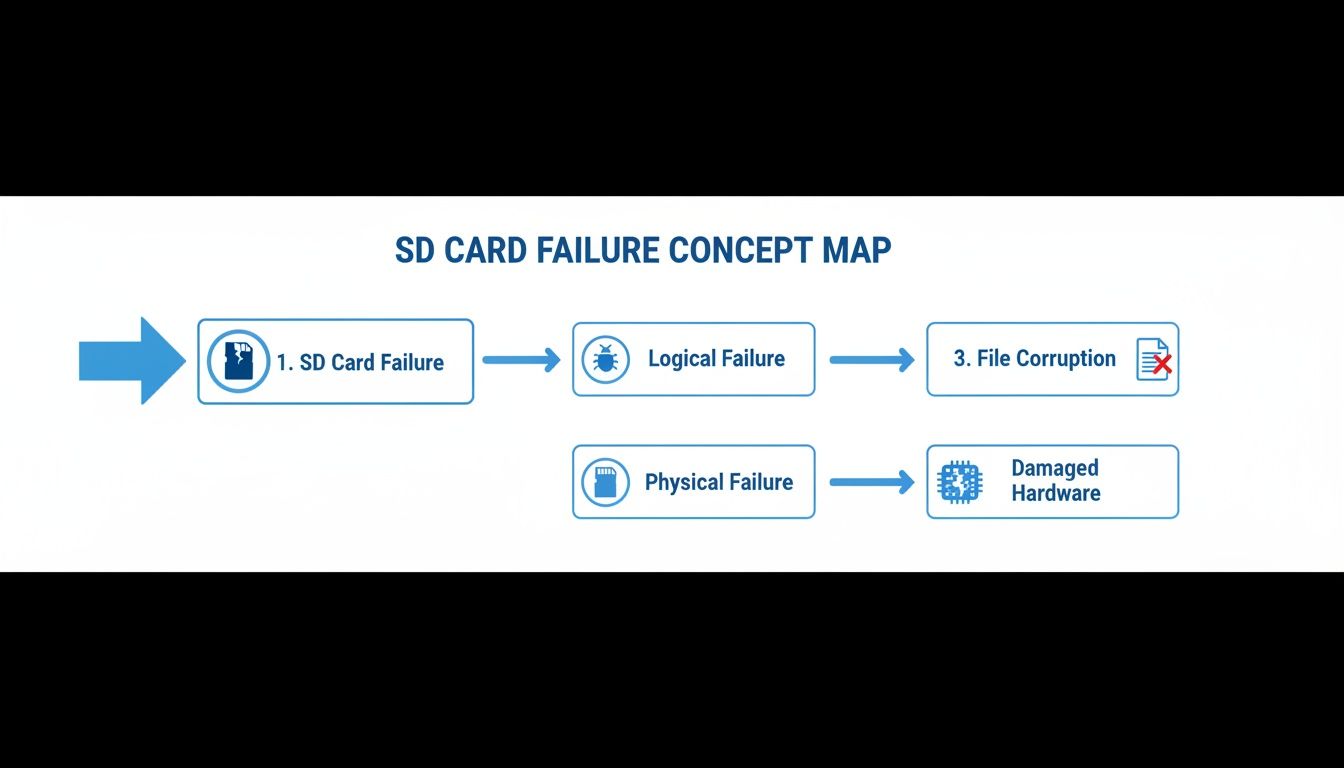
Software is designed to address logical issues. It is completely ineffective against physical hardware damage.
Selecting the Right Recovery Tool
The market is saturated with data recovery tools, many of which are inadequate. Free utilities often lack the sophisticated algorithms required to reconstruct complex file types like modern video codecs or RAW camera files. Worse, some are bundled with malware or attempt to "repair" the card by writing data back to it, which should be avoided at all costs.
When evaluating software, look for professional-grade capabilities.
Key Features in Reputable Data Recovery Software
| Feature | Why It Matters for SD Card Recovery | What to Look For |
|---|---|---|
| Scans Disk Images | This is the foundation of non-destructive recovery, allowing you to work on a clone while preserving the original card. | The software must list "scan from image file" or a similar function. If it only scans physical drives, it is not a professional-grade tool. |
| RAW File Signature Support | For photographers, this is essential. It identifies files based on their unique data structure (.CR2, .NEF, .ARW) even if the file system is completely gone. | Look for a comprehensive list of supported RAW formats from major camera manufacturers like Canon, Nikon, Sony, and Fujifilm. |
| File Preview Function | This allows you to verify a file's integrity before saving it, preventing the recovery of corrupted or unusable files. | The tool should offer a clear preview for common file types (JPG, MP4, MOV). A hex viewer is a useful feature for advanced analysis. |
| Advanced Scan Options | A "quick scan" often misses deleted files. A "deep scan" is necessary to thoroughly analyze every sector of the card for recoverable file fragments. | The software should provide distinct "quick" and "deep" scanning modes and explain the purpose of each. |
These features are critical for success. In independent tests, a professional-grade tool like EaseUS Data Recovery Wizard demonstrated a 98.30% recovery success rate. Another option, Disk Drill, achieved 94%. In contrast, a well-regarded open-source tool like PhotoRec, despite its capabilities, only managed a 49.20% success rate in the same tests. You can review the full comparison in this full SD card software analysis. The underlying technology matters.
The Final Steps: Scanning and Saving
With your disk image created and a reputable tool selected, you can begin the scan. Direct the software to your image file - not the physical card - and initiate a "deep scan." This process can take several hours, depending on the card's capacity and your computer's speed. Do not interrupt it.
After the scan completes, use the preview function to verify the integrity of your most important files. Check that photos are not corrupted and that videos play correctly.
When you are ready to save the recovered data, follow this final rule: Never save the recovered files back to the original SD card. Doing so will overwrite the very deleted data you are trying to recover.
Create a new folder on a separate physical drive - your computer's internal drive or an external hard drive - and save all recovered files there. Only after you have confirmed that your essential data is safe and functional should you consider reusing the original SD card.
When to Stop and Contact a Professional
Recognizing the limitations of DIY recovery is one of the most important factors in a successful outcome. It is not about giving up; it is about knowing when your efforts could be causing more harm than good. Continuing to scan a physically failing SD card can actively destroy the data you are trying to save.
If you observe any of the following symptoms, the safest course of action is to stop. Power down the device, remove the card, and store it safely. Every moment it is powered on increases the risk of irreversible damage.
Clear Signs You Need a Data Recovery Lab
When the hardware inside an SD card fails, software is useless. It is analogous to trying to use a key on a door that has been removed from its hinges; the tool cannot work because the underlying structure is broken.
These are definitive signs of physical failure:
- The Card Is Not Detected: You have tried the card in multiple devices and card readers, but it does not appear. This almost always indicates a hardware failure, such as a dead controller chip or damaged connectors.
- The Capacity Is Incorrect: A common symptom of controller failure is when a card reports an incorrect size. For example, your 128GB card suddenly shows up as 0MB, 32MB, or another nonsensical value. This means the card's "brain" can no longer communicate with the NAND memory chips where your data is stored.
- Obvious Physical Damage: If the card is cracked, bent, water-damaged, or has broken connector pins, do not plug it in. Powering on a physically compromised device risks a short circuit that can permanently destroy the memory chips.
A Note From Our Lab: We frequently see cases where a client has run repeated scans on a card with a failed controller. Each attempt puts more electrical stress on the failing components, which can degrade the NAND memory cells and make a successful recovery far more difficult, if not impossible.
Understanding the Underlying Failure
These symptoms point to serious internal problems. A failed controller chip means the microprocessor that manages data flow and error correction is non-functional. In our lab, we must bypass it entirely. Another common issue is NAND degradation, where the memory cells have worn out from excessive read/write cycles, leading to widespread corruption that software cannot resolve.
When these failures occur, recovery requires advanced, hardware-level techniques. This often involves a "chip-off" recovery, where our engineers physically remove the NAND memory chip from the circuit board in a clean-room environment. We then use specialized hardware readers to access the raw data directly from the chip. For complex cases like these, our New York data recovery lab has the necessary tools and expertise.
It's also important to set realistic expectations about success rates. Some companies may dismiss a significant percentage of cases upon arrival as "unrecoverable," which can artificially inflate their success statistics for the cases they accept. The true success rate across all submitted devices is often a more nuanced story, as detailed in this analysis of how recovery success rates are calculated.
If your irreplaceable data is at stake and you observe any of these red flags, a DIY attempt is too risky. Have the device professionally evaluated. Our nationwide mail-in diagnostics can determine the exact failure without putting your data at further risk.
Inside a Professional Data Recovery Lab
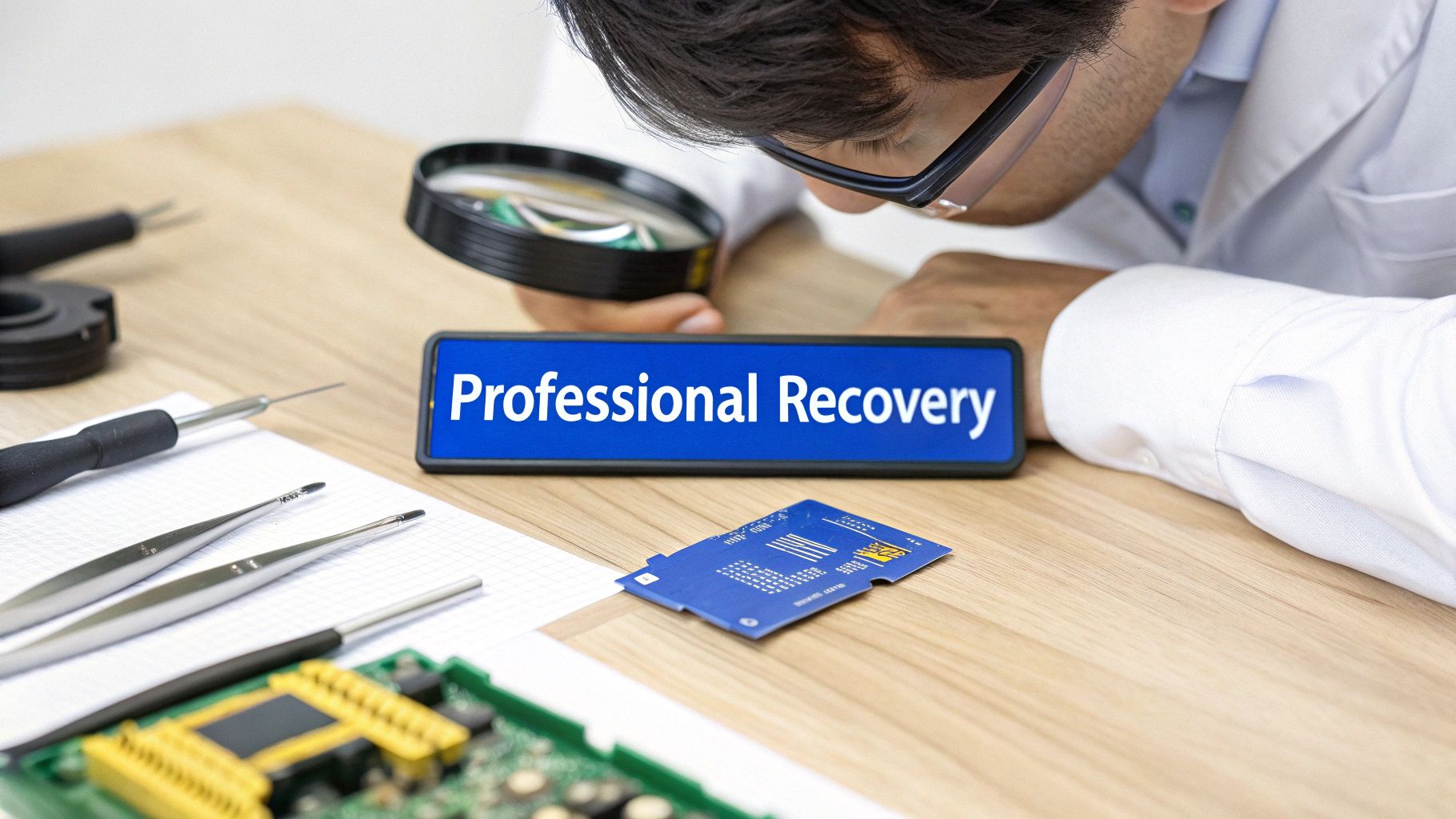
Entrusting your personal data to a lab can be a daunting decision. We want to provide transparency into what happens when your SD card arrives at a professional facility like MDRepairs. This is a controlled, secure environment where every procedure is optimized for the safe recovery of your data.
Our nationwide mail-in service is designed to be professional and transparent from start to finish.
The Diagnostic Phase: Identifying the Root Cause
Upon arrival, your SD card undergoes a comprehensive diagnostic evaluation. This is not a software scan; it is a deep, no-obligation assessment to determine the precise cause of failure using specialized hardware that interfaces with the card at a level far below the operating system.
This initial evaluation reveals critical information:
- Controller Chip Status: The health of the card's processor dictates the recovery strategy.
- NAND Memory Accessibility: We verify if we can establish a stable connection to the memory chips where your data is stored.
- Failure Type: We pinpoint whether the issue is logical (file system corruption), firmware-related, or physical (failed controller, damaged memory).
We use industry-standard tools like the PC-3000 Flash to analyze the card's electronic signals, allowing us to identify the root cause without writing any data to your card and risking further damage.
Advanced Recovery Techniques
When the diagnosis reveals a severe physical or electronic failure, we employ techniques that are impossible to perform outside a lab. For many failed SD cards, this requires a 'chip-off' recovery.
This procedure is analogous to microsurgery. In a certified clean-room environment, our engineers de-solder the NAND memory chip from the SD card's circuit board. This tiny component contains all of your data. It is then placed into a specialized reader that can interpret the raw data directly, completely bypassing the failed controller chip.
Why is this necessary? A failed SD card controller is like a librarian with amnesia - the books (your files) are on the shelves, but there's no way to find them. The chip-off process allows us to read every single page on every shelf and reconstruct the library's contents from the raw data.
Transparent Process and Secure Data Return
Following the diagnosis, we provide a detailed report and a firm, upfront quote. Our no data, no charge policy ensures that if we cannot recover the files you need, you do not pay for the recovery service.
Upon your approval, we proceed with the full recovery. For chip-off cases, this involves complex engineering to unscramble the raw data, reverse-engineer the manufacturer's data-mixing algorithms, and reconstruct the original file system. We handle cases from across the country, and our California data recovery lab adheres to this same meticulous process.
Finally, your data is returned securely. We will never return files on the original, failed SD card. Instead, we transfer your recovered data to a new, high-quality USB flash drive, ensuring it is safe, stable, and immediately accessible.
How to Prevent SD Card Data Loss
The most effective data recovery is the one that is never needed. Adopting a few simple best practices can significantly reduce your risk of data loss. Proactive data integrity management begins long before a file is ever deleted.
It starts with using reliable media, which means choosing the best SD card for your specific application.
Investing in high-quality cards from reputable manufacturers is your first line of defense. Inexpensive, unbranded cards often use lower-grade NAND memory, making them far more susceptible to corruption and premature failure.
Best Practices for Handling SD Cards
Everyday habits have a significant impact on a card's longevity and reliability. Consistently following these steps can help prevent logical corruption, one of the most common causes of data loss.
- Always Eject Safely: Never physically remove a card from a computer or camera without using the "Safely Remove Hardware" or "Eject" command. This ensures all write operations are finalized and prevents file system corruption.
- Format in the Primary Device: When using a new card, format it within the camera or device where it will be primarily used, not on a computer. This optimizes the file system for that specific device, reducing the risk of compatibility errors.
- Avoid Maximum Capacity: Consistently filling a card to 100% capacity places stress on its controller and memory. Leaving a small amount of free space can help prevent file system errors and extend the card's lifespan.
The most critical preventative measure is a robust backup strategy. The 3-2-1 rule is the industry standard: maintain at least three copies of your data on two different types of media, with one copy stored off-site. Your data is not truly safe until it exists in multiple locations.
Frequently Asked Questions About SD Card Recovery
In our lab, we encounter a wide range of questions about SD card data recovery. Here are answers to some of the most common inquiries.
I Accidentally Formatted My SD Card. Is the Data Gone Forever?
Not necessarily. A "quick format" typically only erases the file system's index, not the underlying data itself. It effectively tells the device that the space is now available for use.
The critical factor is what happens after the format. You must stop using the card immediately. Any new data written to the card can overwrite the sectors containing your original files, making them unrecoverable. As long as the data has not been overwritten, professional tools can often reconstruct the file structure and recover the "lost" files.
How Much Does Professional SD Card Recovery Cost?
The cost is determined by the nature of the failure. The complexity of the problem is the primary factor.
A straightforward logical issue, such as an accidental deletion or format, represents the lower end of the cost spectrum. However, if the card has failed physically and requires a ‘chip-off’ recovery, the cost is higher. This delicate procedure involves removing the NAND memory chip and is a time-intensive, highly skilled process.
This is why MDRepairs begins every case with a no-obligation diagnostic. We provide a detailed assessment and a firm quote before any work begins. Our 'no data, no charge' policy means you only pay for the recovery service if we successfully retrieve the files you need.
Is It a Bad Idea to Use Free Recovery Software?
It can be risky. While some free tools are legitimate, many are bundled with malware, are ineffective, or, in the worst-case scenario, can write data to your card during the scan, permanently overwriting the files you are trying to recover.
If the data is not critical and you wish to try software, use a reputable program that offers a free trial to preview recoverable files before purchasing. For any irreplaceable data, the safest approach is always to seek a professional evaluation first.
If you are facing a data loss situation and are not comfortable with the risks of a DIY attempt, MDRepairs can provide a professional, safe, and effective solution. We offer nationwide mail-in diagnostics to determine the best path forward for recovering your data.
How MDrepairs can help
Real cases like this come through our New Jersey lab every week. If you are dealing with one now, start here.
- Flash Drive & USB Data Recovery Chip-off recovery from snapped and unreadable USB drives. Learn more
- Data Recovery Services Every device and failure type, recovered in our New Jersey lab. Learn more
- Hard Drive Data Recovery Mechanical, firmware and logical HDD recovery on every brand. Learn more
- SSD Data Recovery Controller, NAND and firmware recovery for SATA, M.2 and NVMe SSDs. Learn more