How to Fix a Corrupt HDD: A Professional Data Recovery Guide
In this article
When you suspect your hard drive is corrupt, your actions in the next few minutes can determine whether your data is recoverable or permanently lost. The single most important first step is to power down the device immediately. Continuing to use a failing drive - even for a few minutes - can turn a recoverable situation into an irreversible failure, especially if the problem is physical.
This guide, written from the perspective of a professional data recovery lab, will walk you through the critical first steps, help you understand what's actually wrong with your drive, and explain when a DIY approach is safe versus when you need to stop and seek professional help.
What to Do Immediately When You Suspect a Corrupt Hard Drive
The term "corrupt hard drive" can describe anything from a minor file system error to a catastrophic mechanical failure. Your initial response is crucial. Panicking and running random software can quickly escalate the problem, sometimes causing permanent data loss on a drive that was otherwise recoverable.

The first step is to diagnose the type of failure you're facing. Drive failures fall into distinct categories, and the recovery strategy for each is completely different.
Understanding Logical vs. Physical Failure
The most common mistake we see is treating all drive problems the same. It is essential to distinguish between a logical and a physical issue before attempting any fix.
Logical Failure: This is a software-level problem. The drive's hardware is physically sound, but the data structures - the "map" that tells the operating system where to find files - are damaged. Think of a library with a scrambled card catalog. The books (your data) are still on the shelves, but the system to locate them is broken. This is often caused by accidental formatting, viruses, or sudden power loss during a file-write operation.
Physical Failure: This means a hardware component inside the drive has broken. This could be a head crash, where the read/write heads contact the fragile data platters, or a seized motor that prevents the platters from spinning. Physical failures are often accompanied by distinct sounds like clicking, grinding, or buzzing.
To help you diagnose the situation, consult the table below.
Quick Guide to Hard Drive Symptoms
Use this table to identify the likely cause of the failure based on the drive's behavior.
| Symptom | Potential Cause | Your Safest First Action |
|---|---|---|
| Clicking, grinding, or buzzing noises | Mechanical Failure (Head crash, motor failure) | Power off immediately. Do not run any software. Continued use will cause severe platter damage. |
| Drive not detected in BIOS/Disk Utility | Electrical, Firmware, or Mechanical Failure | Power off immediately. This is a critical symptom requiring professional diagnostics. |
| Computer is very slow, freezes, files disappear | Logical or Mechanical Failure (Bad sectors, failing heads) | Power off and stop use. The drive surface may be degrading. A professional evaluation is the safest path. |
| "Drive not formatted" or RAW filesystem error | Logical Failure (Corrupt partition table, filesystem) | Power off. The safest next step is to create a sector-by-sector clone before attempting any software recovery. |
This table provides a starting point, but symptoms can overlap. When in doubt, powering down is always the safest course of action.
The Dangers of Common Repair Tools
When a drive misbehaves, it's tempting to use built-in utilities like Windows' CHKDSK or macOS's Disk Utility. While these tools can fix minor logical errors on a healthy drive, running them on a physically failing one is often catastrophic.
These utilities perform intensive read and write operations. If the drive has weak or damaged read/write heads, this stress can cause a complete head crash, carving circular scratches into the platters and destroying your data permanently. It's like forcing an athlete with a stress fracture to run a marathon - a severe injury is almost guaranteed.
Professional Insight: The most common cause of preventable, permanent data loss we see in our lab is when a user runs CHKDSK on a physically failing drive. The initial problem was often recoverable, but the repair attempt destroyed the platters.
The Golden Rule: Create a Clone First
Before attempting any software-based fix, the non-negotiable first step is to create a sector-by-sector clone of the failing drive. This isn't just copying files; it's making an exact, bit-for-bit duplicate of the entire drive onto a healthy one.
This is the cornerstone of professional data recovery for two critical reasons:
- It Preserves the Original Drive: The fragile patient drive is only powered on for the minimum time required to create an image. This prevents further wear and tear.
- It Provides a Safe Working Copy: All recovery attempts are performed on the clone. If a software tool corrupts the file system further, it's not a disaster. You can simply make a new clone from the original source.
At MDRepairs, our nationwide mail-in service begins with professional diagnostics to determine the true nature of the failure. Without an accurate diagnosis, any DIY attempt is a blind gamble with your data.
Understanding Why Hard Drives Actually Fail
"Corruption" is a symptom, not the root cause. A hard drive is a complex electromechanical device, and failure typically stems from one of four distinct issues. Misdiagnosing the failure type is the primary reason DIY recovery attempts fail and cause further damage.
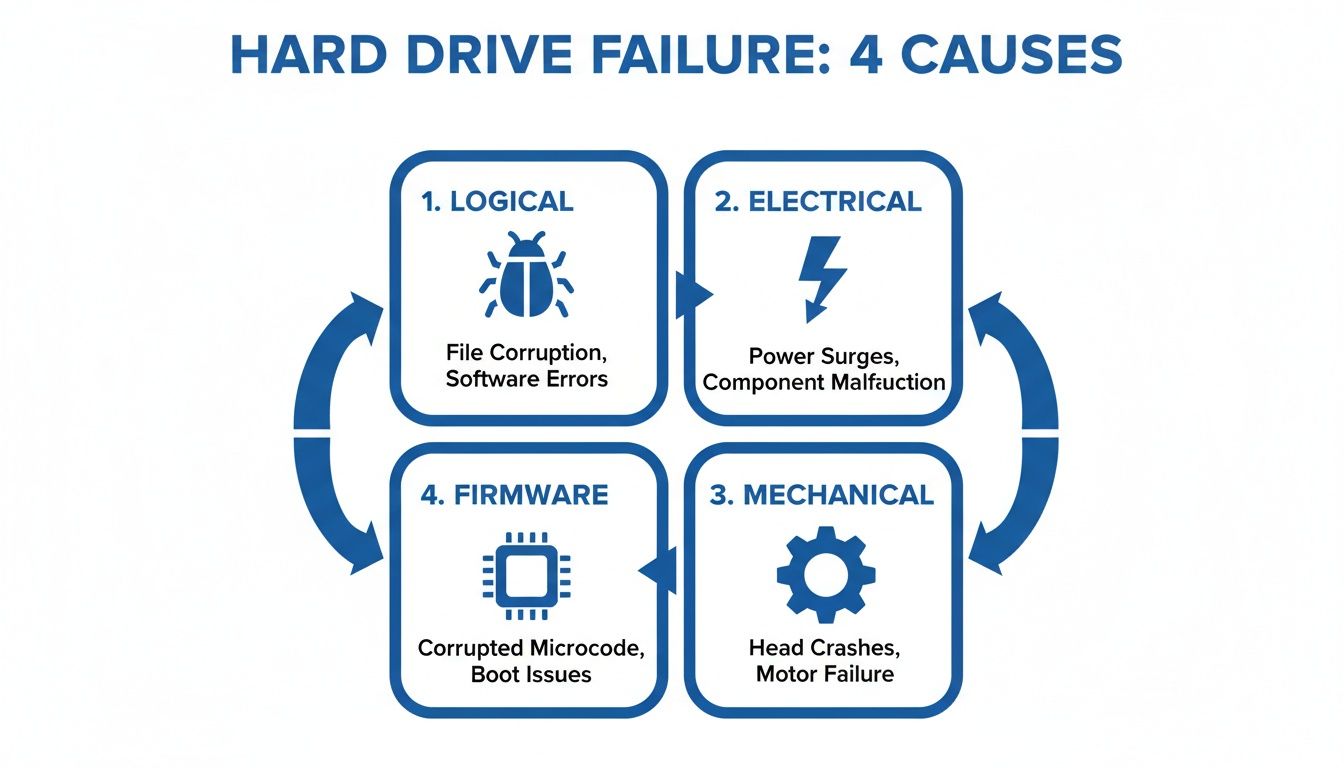 hard drive failure: logical, electrical, mechanical, and firmware issues." />
Knowing the difference between these failure types is the first step toward understanding if your data is recoverable and what the correct approach should be.
Logical Failures: The Software Problem
Logical failures are the most common and often the most recoverable type of failure without needing a clean-room environment. In these cases, the drive's hardware is functioning correctly, but the data organization is compromised.
Common causes include:
- Accidental Formatting: Wipes the file system pointers, making data invisible to the OS.
- Virus or Malware: Can encrypt files, delete partition tables, or corrupt system data.
- Sudden Power Loss: Can interrupt a write process, leaving the file system in an inconsistent, unreadable state.
- Software Glitches: Bugs in an application or operating system can cause data corruption.
This is the only category of failure where data recovery software can be safely and effectively used, and even then, only on a clone of the original drive.
Electrical Failures: The Circuitry Issue
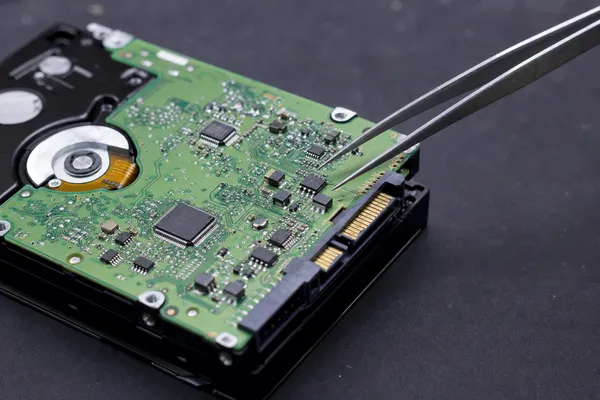
An electrical failure occurs when the Printed Circuit Board (PCB) on the hard drive is damaged, often by a power surge. The PCB acts as the drive's command center, controlling everything from the spindle motor to communication with the computer.
When the PCB fails, the drive will typically be completely dead - no spin, no sound, no signs of life. A common myth suggests swapping the PCB with one from an identical drive, but this has not worked for over a decade. Modern drives store unique, adaptive calibration data on a ROM chip on the PCB. A professional must transplant this specific ROM chip to a compatible donor board to access the drive's data without causing internal damage.
Mechanical Failures: The Physical Breakdown
This is the most critical type of failure. A mechanical failure means a physical component inside the sealed drive has broken. These situations are extremely time-sensitive.
If you hear clicking, grinding, or buzzing sounds, this is the universal distress signal of a severe mechanical failure. Power it down immediately. Every second it remains powered on, it is likely causing irreversible platter damage.
Common mechanical failures include:
- Head Crash: The read/write heads, which float nanometers above the spinning platters, make physical contact, scraping away the magnetic layer where data is stored.
- Seized Spindle Motor: The motor that spins the platters fails, preventing the drive from spinning up.
- Stiction: The read/write heads become stuck to the platter surface when the drive is powered off.
Recovering from a mechanical failure requires a certified clean-room, specialized tools, and a stock of compatible donor drives for parts. This is never a DIY procedure.
Firmware Failures: The Operating System Glitch
Firmware is the drive's internal operating system, stored in a hidden area of the platters called the service area. It manages the drive's core functions, and when it becomes corrupted, the drive can exhibit very strange symptoms.
A drive with a firmware failure might be identified with the wrong model name, report its size as 0GB, or get stuck in a "busy" state indefinitely.
Consumer software cannot fix firmware issues. Recovery requires professional tools like the PC-3000, which allow engineers to directly access the service area and repair the damaged firmware modules. Running standard recovery software on a drive with a firmware problem is ineffective and can sometimes complicate the recovery process.
A Professional Approach to Safe Hard Drive Diagnostics
In a professional data recovery lab, our guiding principle is do no harm. Every diagnostic step is designed to prevent further stress on a failing drive. This is the same cautious mindset you should adopt. Before running any software that reads from or writes to the drive, you must perform non-intrusive checks to understand the nature of the problem.
Software-based fixes are only safe and effective for logical problems. Using them on a physically failing drive can be catastrophic.
Checking S.M.A.R.T. Status for Early Warnings
Your first safe diagnostic step is to check the drive's S.M.A.R.T. (Self-Monitoring, Analysis, and Reporting Technology) data. This is a built-in health monitoring system that can often provide early warnings of impending hardware failure.
You can view this data with free, read-only tools like CrystalDiskInfo for Windows or Hard Disk Sentinel. These utilities simply query the drive for its health status without performing stressful operations.
Pay close attention to these key attributes:
- Reallocated Sectors Count: The number of bad sectors the drive has already retired. A high or increasing number is a major red flag of media degradation.
- Current Pending Sector Count: Unstable sectors the drive is having trouble reading. A high count indicates the drive is actively failing.
- Uncorrectable Sector Count: Read errors so severe that the drive's internal error correction failed. Any value above zero is a serious concern.
Lab Insight: A drive showing a "Caution" or "Bad" S.M.A.R.T. status, especially with a rising Reallocated Sectors Count, is a ticking time bomb. Attempting to "fix" it with aggressive software is extremely risky. At this point, even cloning must be done with specialized hardware to minimize stress.
The Non-Negotiable Step: Creating a Sector-by-Sector Clone
If the drive passes a physical inspection (no strange noises) and its S.M.A.R.T. status is not critical, the next step is creating a sector-by-sector clone.
This is an exact, bit-for-bit duplicate of the entire drive - good sectors, bad sectors, and all - onto a healthy target drive of equal or larger capacity. This process is the foundation of professional data recovery because it protects the original, fragile drive from further stress. Once the clone is complete, the original drive is powered down and safely stored. All recovery attempts are then performed on the stable clone.
While software like ddrescue (Linux) or HDD Raw Copy Tool (Windows) can create a clone, they can be risky on an unstable drive. A drive with weak heads can fail completely under the strain of a software-based imaging process. In our lab, we use hardware imagers that provide granular control over power, head activity, and read timings, allowing us to safely extract data from unstable sectors.
If you attempt to clone the drive and it is extremely slow, reports thousands of errors, or starts clicking, stop the process immediately. These are classic signs of a physical failure that requires professional intervention. Pushing the drive further risks turning a recoverable case into a permanent loss. For drives in this condition, professional diagnostics are available nationwide. Exploring options like our New York data recovery services can provide a clear, safe path forward.
Using Software to Fix Logical Hard Drive Corruption
Once you have successfully created a stable, sector-by-sector clone, you can begin attempting a software-based recovery. Remember to work only on the clone, preserving the original drive.
Software tools are designed to fix logical corruption - problems with the file system or partition table. They are completely ineffective for physical, electrical, or firmware failures.
Recovering a Lost Partition with TestDisk
A common logical issue is a damaged or deleted partition table. This makes the operating system see the drive as empty or unformatted, even though the data is still present.
For this specific problem, the open-source tool TestDisk is a powerful option.
- How It Works: TestDisk scans the clone's raw data for signatures that mark the beginning of partitions. It can then reconstruct a new, valid partition table.
- When to Use It: Use TestDisk when the drive appears as "unallocated" or "raw" in Disk Management, and you are certain there are no physical issues (no clicking, good S.M.A.R.T. status).
- The Process: TestDisk's command-line interface guides you through analyzing the drive structure. If it finds the old partitions, it can write a new partition table to the clone, making your files visible again.
A Critical Warning: Never run TestDisk on your original failing drive. Writing an incorrect partition table can permanently overwrite the data structures needed for a professional recovery. Always work on the clone.
"Carving" Deleted Files with PhotoRec
If the partition is intact but you've accidentally deleted files or formatted the drive, the data may still exist on the platters until it's overwritten. This is where file carving tools like PhotoRec (usually packaged with TestDisk) are useful.
PhotoRec ignores the broken file system and scans the clone sector by sector, looking for file headers and footers (the digital fingerprints of file types like JPEGs, PDFs, etc.). When it finds a match, it "carves" out the data and saves it.
However, be aware of the limitations:
- Original Filenames are Lost: Files are recovered with generic names (e.g.,
f123456.jpg) because the file system metadata is gone. - Fragmentation is an Issue: Large files saved in multiple pieces across the drive may only be partially recovered.
The effectiveness of these tools demonstrates why simple deletion is not a secure way to erase data. As you can see, readily available data recovery tools can often recover "deleted" files.
The Dangers of CHKDSK and Filesystem Repair Tools
Built-in utilities like Windows' CHKDSK (chkdsk /r) or macOS's Disk Utility (First Aid) are designed to fix minor file system errors on healthy drives. They are aggressive and can be destructive on a failing drive.
These tools cannot distinguish between a logical error and a physical one. If a bad sector is caused by a weak read head, CHKDSK will repeatedly try to access that area, which can cause the head to crash and destroy the data permanently.
Only run these tools on your clone, and only as a last resort after you have already recovered your most important files using other methods. If software attempts fail, or if the drive showed any physical symptoms, it is time to stop. Further DIY attempts will likely cause more damage.
Red Flags That Demand Professional Data Recovery
Sometimes, a drive is experiencing a severe internal failure where any further DIY attempt - even powering it on - can cause irreversible data loss. These are the clear signs that you need to stop, unplug the drive, and contact a professional data recovery lab.
Recognizing these symptoms is critical. Many drives that arrive at our lab were initially recoverable, but became permanently damaged because the user kept trying to access them.
Alarming Noises from the Drive
A healthy hard drive produces a quiet, consistent hum. Any loud, repetitive, or unusual noise is a sign of a severe mechanical failure.
- Clicking or Ticking: Known as the "click of death," this sound is caused by the read/write head assembly failing to initialize. The arm swings back and forth, hitting its physical stop.
- Grinding or Scraping: This is the worst possible sound. It means the heads have crashed onto the platters and are actively scraping away the magnetic layer that stores your data.
- Buzzing or Beeping: A buzz or beep often indicates a seized spindle motor. The drive is trying to spin the platters but cannot.
If you hear any of these sounds, the drive has suffered a major mechanical failure. Power it down immediately. Every additional second it runs is actively destroying your data.
When the Drive Becomes Invisible
Another set of critical symptoms points to severe firmware or electrical failure - problems that software can never fix.
- Not Detected in BIOS/UEFI: The computer's most basic system cannot see the drive. This is often caused by a failed PCB or a dead head assembly.
- Shows Incorrect Capacity (e.g., 0GB): The drive is detected but reports an incorrect size. This is a classic sign of firmware corruption, where the drive's internal operating system has failed.
When facing these failures, a professional data backup and recovery service is the only safe option. Continuing to power cycle the drive can corrupt the firmware further, making recovery more complex and expensive.
Why a Professional Lab Is Necessary
Symptoms like these indicate problems that require specialized tools and expertise. Internet myths like the "freezer trick" are dangerous and will only cause condensation that destroys the drive's electronics and platters.
A professional lab like MDRepairs uses essential, non-negotiable tools:
- A Certified Clean-Room: A sterile, dust-free environment is required to safely open a hard drive without contaminating the platters.
- Firmware Repair Tools: Specialized hardware like the PC-3000 allows our engineers to directly interface with the drive's service area to repair corrupted code.
- Donor Parts Inventory: We maintain a large inventory of thousands of drives to find matching heads, PCBs, and motors for physical repairs.
Our lab is equipped to handle drives from all manufacturers, and our California data recovery center serves clients across the country. A professional evaluation is the safest way to understand your options. With our no data, no charge policy, you only pay if we recover the files you need, making it a risk-free decision.
Your Hard Drive Recovery Questions, Answered
When faced with potential data loss, you likely have many questions. As data recovery professionals, we hear the same concerns every day. Here are clear, straightforward answers to the most common questions.
Is My Data Recoverable from a Clicking Hard Drive?
Yes, in most cases, data is still recoverable from a clicking hard drive. The clicking sound indicates a mechanical failure of the read/write head assembly. The most important action you can take is to power off the drive immediately to prevent the failing heads from scratching the platters.
In our certified clean-room, engineers can open the drive and replace the failed head assembly with a functional one from a matching donor drive. This delicate procedure allows us to then safely image the data. This is a complex, lab-only repair.
How Long Does Professional Data Recovery Take?
The turnaround time depends entirely on the nature of the failure.
- Logical Issues: For problems like a corrupt file system, recovery can often be completed within 2-5 business days.
- Mechanical/Firmware Failures: These cases are more complex. A head crash or firmware corruption can take longer, especially if we need to source a rare donor drive for parts. The initial diagnosis will provide a clear estimate.
We offer professional diagnostics to give you a precise timeline for your specific case. Optional rush services are also available for urgent situations.
What’s the Safest Way to Mail a Hard Drive for Recovery?
Proper packaging is crucial to prevent further damage during shipping. We provide detailed shipping instructions, but the essentials are an anti-static bag to protect the electronics and a sturdy box with at least two inches of dense padding (like bubble wrap) on all sides. Once your device arrives at our lab, it is logged into our secure system, and you receive an immediate confirmation.
What Happens If My Data Can’t Be Recovered?
This is a critical question. Our service is built on a strict no data, no charge policy.
After our free initial evaluation, we provide a price quote. If you approve the quote but we are ultimately unable to recover the specific files you need, you owe nothing for the recovery service. This makes getting a professional evaluation completely risk-free. You have nothing to lose by determining the exact problem and the chances of a successful recovery. For clients in the Southwest, learn more about our Texas data recovery lab and services.
At MDRepairs, we provide professional, lab-level data recovery services for individuals and businesses nationwide. We handle all types of storage devices, including HDDs, SSDs, RAID systems, and mobile devices. If your data is critical, a professional evaluation is the safest and most reliable path forward. Start your free, no-obligation case online.
When DIY Stops Being Safe
Trying to fix a corrupt HDD is risky when the drive itself may be unstable. Stop if the disk clicks, grinds, disappears during scans, takes a long time to list folders, reports bad sectors, or triggers repeated CHKDSK, Disk Utility, or format prompts. File system repairs can be useful on healthy media, but on a failing hard drive they can force heavy reads and writes at the worst possible time.
If you do one thing safely, make it this: do not repair the original drive before you have a proper clone or a professional plan. Avoid initializing, formatting, rebuilding partitions, or saving recovered files back onto the same disk. MDRepairs provides hard drive repair and recovery support from a real New Jersey lab, starting with a free phone consult and a flat $100 diagnostic applied toward recovery. Their policy is no data, no charge. If you are outside driving distance, the send-in data recovery service lets you ship the HDD from anywhere in the United States.
How MDrepairs can help
Real cases like this come through our New Jersey lab every week. If you are dealing with one now, start here.
- SSD Data Recovery Controller, NAND and firmware recovery for SATA, M.2 and NVMe SSDs. Learn more
- Data Recovery Services Every device and failure type, recovered in our New Jersey lab. Learn more
- RAID Data Recovery Array reconstruction for RAID 0/1/5/6/10, NAS and servers. Learn more
- Data Recovery Cost What recovery really costs - flat tiers, no data no charge. Learn more